
Childminder EYFS Observations and Planning
A Guide to Reducing Paperwork
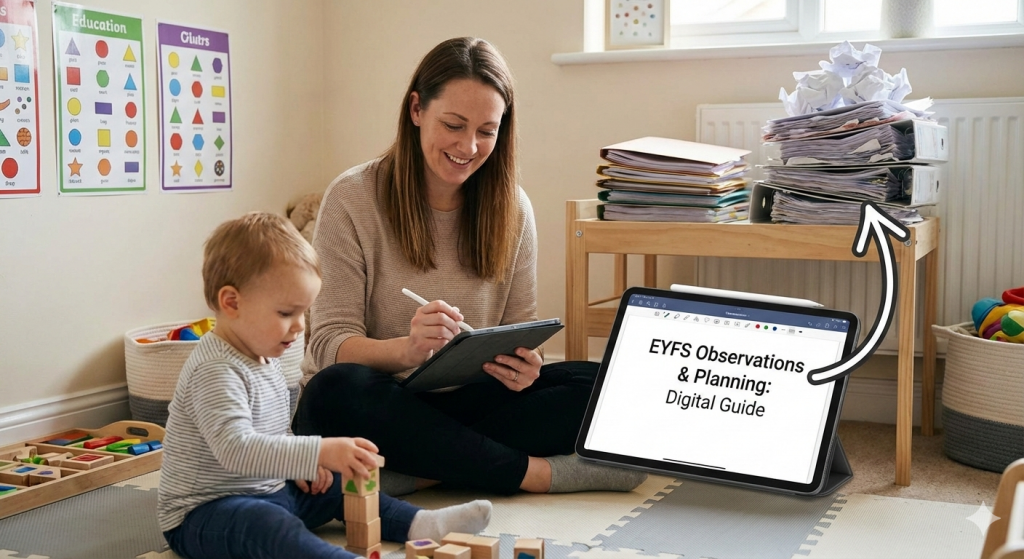
For many childminders, the “EYFS” often feels synonymous with “Endless Yearly Files of Stuff.” However, the 2021 reforms to the Early Years Foundation Stage (EYFS) were specifically designed to reduce the paperwork burden on practitioners.
The goal is to spend more time playing and interacting with children and less time writing about it. This guide explores how to master EYFS observations and planning in a way that satisfies Ofsted while giving you your evenings back.
1. Moving to “In the Moment Planning”
Traditional planning often involves spending hours on Sunday night creating a rigid schedule for the week ahead. In a home-based setting, this rarely works because children’s interests change by the hour.
In the Moment Planning (ITMP) is the practice of spotting a “teachable moment” and responding to it immediately.
How ITMP Works for Childminders:
The Spark: A child notices a spider web in the garden.
The Interaction: Instead of waiting until next week to do a “mini-beast theme,” you grab a magnifying glass and a spray bottle right then.
The Learning: You discuss the patterns (Mathematics), how spiders move (Physical Development), and use descriptive words like “sticky” or “silky” (Communication and Language).
By planning “in the moment,” you eliminate the need for complex forward-planning documents. Your “Implementation” is happening live, and your evidence is the progress the child makes.
2. Quality Over Quantity: Writing Impactful EYFS Observations
One of the most common questions is: “How many observations do I need per child?” There is no statutory number. Ofsted would much rather see one meaningful observation that led to progress than twenty “He played with the cars” notes.
The Anatomy of a Great Observation
To make your childminder paperwork efficient, use the ABC method:
A – Antecedent/Activity: What was the child doing? (e.g., “Leo was trying to stack three wooden blocks.”)
B – Behaviour/Development: What did you notice? (e.g., “He struggled with balance and became frustrated.”)
C – Concept/Next Step: What did you do to help? (e.g., “I modelled how to place the larger block at the bottom. Leo then successfully stacked four.”)
This simple note proves you understand the child’s needs and have provided the “Impact” required by the Education Inspection Framework (EIF).
3. Tracking the “Characteristics of Effective Learning” (CoEL)
Inspectors aren’t just looking at what children learn, but how they learn. The CoEL are the secret weapon of an “Outstanding” childminder. These are:
Playing and Exploring: Are they “having a go”?
Active Learning: Do they keep trying if they encounter a challenge?
Creating and Thinking Critically: Do they have their own ideas and find ways to solve problems?
Instead of writing a separate report for these, try to tick them off or mention them within your standard observations. Showing that a child “persisted with a difficult puzzle” is better evidence of development than simply saying they finished it.
4. Setting Up Your Home for Self-Directed Learning
To reduce your planning workload, your environment needs to do some of the work for you. This is known as Continuous Provision.
When your resources are accessible (e.g., low shelves with clear bins), children can lead their own learning. Your role shifts from a “teacher” who has to entertain them to a “facilitator” who observes their natural interests.
5. Preparing for the “Learning Walk”
During an Ofsted inspection, the inspector will likely ask you to do a “Learning Walk.” They will ask you to talk about the children in your care without looking at your files.
You should be able to explain:
Where each child is in their development.
What they are currently interested in.
What their “Next Step” is (e.g., “We are working on Sarah’s fine motor skills so she can start using safety scissors”).
If you can speak confidently about these three points, the amount of physical paperwork you have becomes secondary.
Final Tips for Paperwork Efficiency
Go Digital: Consider using apps like Tapestry or Kinderly. They allow you to snap a photo and tag the EYFS area in seconds.
Use a “Communication Diary”: A simple notebook shared with parents can serve as both a daily log and an observation record.
Group Observations: If you take all the children to a forest school and they all learn about autumn leaves, write one observation and copy it into everyone’s file.
➡️ Internal Link Suggestion: Ensure you have the right legal framework for your settings by reviewing our Childminder Policies and Procedures guide.
The Childminding Journey Made Simple: Your All-in-One EYFS Solution
If the EYFS still feels overwhelming, that’s normal.
Every childminder feels this way at the beginning.
That’s exactly why I created the Become a Registered Childminder in the UK – Step-by-Step Course.
Inside the course, you’ll get:
✔ Clear EYFS explanations (no jargon)
Understand what Ofsted wants and how to meet the requirements easily.
✔ Real examples from childminders I’ve trained
Learn how they passed inspection and set up their homes.
✔ Ready-made templates
Policies, contracts, risk assessments, planning sheets.
✔ Video walkthroughs of each step
So you never feel lost or overwhelmed.
✔ Everything for just £49
And you keep all your profits — no agency fees.
Why This Course is Your Essential Tool:
Saves Months of Guesswork: Get clear, beginner-friendly guidance with no jargon, so you know exactly what to do and in what order.
Avoids Costly Mistakes: Set up correctly from the very start, avoiding common pitfalls that delay registration or cost you money.
Everything You Need: The course provides clear video lessons, written guides, essential checklists, and editable templates for your policies and contracts.
Proven Support: Built by professionals who’ve opened nurseries and successfully registered multiple childminders, giving you real inspection examples.
Affordable Investment: For a single, one-time payment of £49.00, you get lifetime access and save hundreds in potential agency fees by learning to register directly.
By the end of this course, you will not only know exactly how to register with confidence but also be ready to run your business professionally and profitably.
Ready to take the confusion out of registration?
Not Ready to Enrol Yet? Get Your Free Childminder Startup Guide
We understand that becoming a childminder is a big decision, and you might need a little more clarity before investing.
Download our FREE Childminder Startup Checklist to get a head start on planning your business and preparing your home.
Inside, you’ll get:
-
The 3 Essential Steps you can take today without spending a penny.
-
A breakdown of the initial costs to expect.
-
A summary of the required space and equipment.
This is the perfect next step for anyone in the planning stage.