
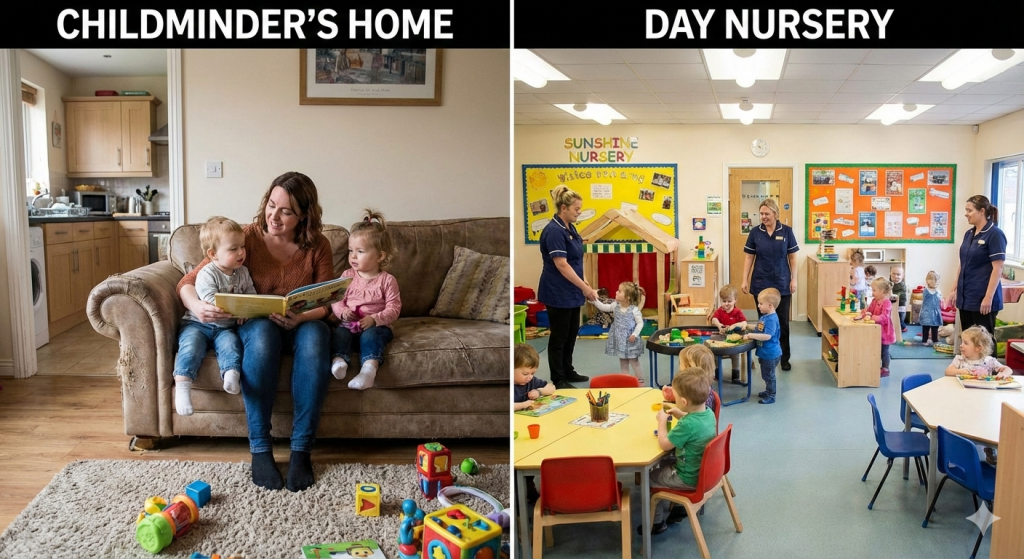
The Core Differences: Environment and Ratios
At the heart of the childminder vs nursery debate is the environment in which your child will spend their most formative years.
Small Group Ratios: The 1:3 Advantage
One of the most compelling home-based childcare advantages is the adult-to-child ratio. While nurseries often operate in large rooms with multiple staff members and dozens of children, a registered childminder typically cares for a maximum of three children under the age of five (including their own).
This 1:3 ratio ensures that your child isn’t just “one of the crowd.” It allows for:
Deep Attachment: The “Key Person” approach is built-in. Your child forms a primary bond with one consistent adult rather than a rotating team of nursery practitioners.
Immediate Response: Whether it’s a nappy change, a cuddle, or a question about a ladybird in the garden, a childminder can respond instantly.
Tailored Learning: Every activity is designed specifically for the children present that day, rather than a generic “one size fits all” nursery curriculum.
A “Home-from-Home” Environment
 A nursery is a commercial premises; a childminding setting is a home. For many children, especially those under three, the transition from their own home to a large, noisy nursery can be overwhelming. Childminders provide a “bridge” between family life and formal education. Learning happens in a kitchen, a living room, or a local park, familiar, cosy environments that reduce cortisol levels and promote a sense of security.
The Financial Reality: Childminder Costs vs Nursery Fees
For many families, the decision is also a financial one. When comparing childminder costs vs nursery fees, the data often reveals a surprising trend.
Transparency in Pricing
Nursery fees are often “all-inclusive,” but they can come with rigid payment structures. You might be charged for 52 weeks of the year, regardless of whether the nursery is closed for bank holidays or your family is on vacation.
Childminders, as self-employed business owners, often offer more nuanced pricing. While many charge for the space (as detailed in our guide on Childminder Contracts and Payment Policies), the hourly rate is frequently more competitive than nursery “day rates.”
Government Funding and Tax-Free Childcare
A common myth is that government funding (the 15 and 30-hour schemes) can only be used at nurseries. This is incorrect. Most registered childminders are “funding-ready.” You can use:
Tax-Free Childcare: Save 20% on your childcare costs.
15/30 Hour Funding: For eligible 2, 3, and 4-year-olds.
Universal Credit Childcare: To claim back up to 85% of your costs.
External Resource: Check your eligibility for childcare support on the official government portal: Childcare Choices – GOV.UK
Socialisation and Community Integration
A frequent concern parents have is: “Will my child be socialised enough if they aren’t in a big nursery?” The reality of modern childminding is quite the opposite.
Real-World Socialisation
In a nursery, children are usually segregated by age (the “Baby Room,” the “Toddler Room,” the “Pre-School Room”). While this seems organized, it isn’t how the real world—or a family—works.
Childminders offer multi-age grouping. A toddler learns empathy by watching a baby, and a younger child’s language skills are fast-tracked by listening to an older child. Furthermore, childminders take children out into the community. A typical week might include:
Library “Rhyme Time” sessions.
Local playgroups and soft play.
Trips to the greengrocer or the post office.
Forest school sessions in local woodlands.
This “real-world” socialisation helps children develop confidence in a variety of settings, not just within the four walls of a classroom.
Flexibility for Modern Working Families
The rigid “7 am to 6 pm” nursery model doesn’t work for everyone. One of the standout home-based childcare advantages is flexibility.
Bespoke Hours
Need a 7:15 am start because of a train commute? Or a 6:15 pm finish because of traffic? Childminders are often much more willing to negotiate bespoke hours that nurseries simply cannot accommodate.
Continuity of Care
Nursery staff turnover is a significant issue in the UK childcare sector. It is common for a child to have three or four different “Key Persons” in a single year as staff move on. With a childminder, you have one consistent professional for the duration of your child’s early years. This continuity is vital for a child’s emotional stability and their ability to reach EYFS milestones.
Quality and Regulation: The Ofsted Factor
Parents often feel “safer” with nurseries because they see a large building with a big logo. However, childminders are held to the exact same standards.
Identical Inspection Frameworks
Every registered childminder in England is inspected by Ofsted under the same Early Years Foundation Stage (EYFS) framework as the biggest nurseries in the country. They are graded on:
Quality of Education
Behaviour and Attitudes
Personal Development
Leadership and Management
When you choose an “Outstanding” or “Good” childminder, you are choosing a practitioner who has proven they can deliver top-tier education and safeguarding.
Safeguarding in a Home Setting
Because childminders work alone or with a small team, they are often more attuned to the subtle changes in a child’s wellbeing. Safeguarding is the cornerstone of their registration.
➡️ Parents should feel confident knowing that their provider is fully compliant. Childminders can find more on this in our article on Safeguarding Compliance: Beyond the Training Course.

How to Choose: The Checklist for Parents
If you’ve decided that a childminder is the right route for your family, here is how to find the perfect match:
Check the Ofsted Report: Ask to see their latest inspection report or find it on the Ofsted website.
Observe the Interaction: When you visit, don’t just look at the toys. Look at the childminder. Does their face light up when they talk about the children?
Ask About Daily Routines: How do they handle naps, meals, and outings? Does it align with your child’s current rhythm?
Review the Policies: A professional childminder will have a clear Childminder Contract and a folder of policies covering everything from sickness to screen time.
Trust Your Gut: You are choosing a partner in your child’s upbringing. You need to feel a sense of trust and shared values.
Conclusion: The Personal Touch
The benefits of a childminder ultimately come down to the “personal touch.” In a nursery, your child is a client. In a childminding setting, they are part of a small, extended family unit.
For parents who value high ratios, consistent emotional bonds, real-world experiences, and flexible care, the choice is clear. While nurseries have their place, the home-based model offers a unique foundation that prepares children for school and life in a way that a commercial setting simply cannot replicate.

If the EYFS still feels overwhelming, that’s normal.
Every childminder feels this way at the beginning.
That’s exactly why I created the Become a Registered Childminder in the UK – Step-by-Step Course.
Inside the course, you’ll get:
✔ Clear EYFS explanations (no jargon)
Understand what Ofsted wants and how to meet the requirements easily.
✔ Real examples from childminders I’ve trained
Learn how they passed inspection and set up their homes.
✔ Ready-made templates
Policies, contracts, risk assessments, planning sheets.
✔ Video walkthroughs of each step
So you never feel lost or overwhelmed.
✔ Everything for just £49
And you keep all your profits — no agency fees.