If you are planning to register as a childminder in the UK, you will constantly hear one acronym: EYFS. The Early Years Foundation Stage (EYFS) is the mandatory statutory framework that sets the standards for the learning, development, and care of children from birth to age five. Understanding the EYFS for childminders is essential for compliance and running a successful home business.
While the official documentation can seem overwhelming, the core principles are intuitive and based on giving children the best start in life.
Here is a simple breakdown of the EYFS and what it means for your home-based childcare setting.
1. The Four Guiding Principles of the EYFS
The framework is built around four central themes that guide your practice and interactions with the children in your care:
A. A Unique Child
Every child is constantly learning and can be resilient, capable, confident, and self-assured. You must recognise that all children develop at different rates and learn through different methods.
B. Positive Relationships
Children learn to be strong and independent through secure relationships. As a childminder, you must foster positive relationships with the children and maintain strong, open communication with their parents.
C. Enabling Environments
The environment plays a key role in supporting and extending children’s development and learning. This means your home setting must be safe, stimulating, and tailored to the children’s specific needs and interests.
D. Learning and Development
Children develop and learn in different ways and at different rates. This principle covers the seven areas of learning you must plan for (detailed below).
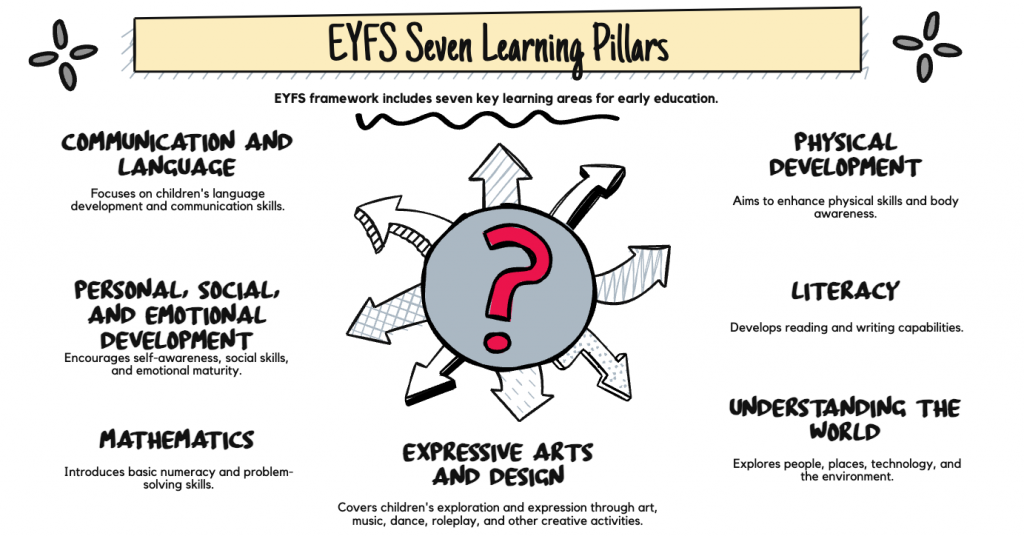
2. The Seven Areas of Learning (What You Must Teach)
The EYFS divides a child’s learning into seven areas, which you must use to plan activities and track progress. They are split into Prime Areas and Specific Areas:
Prime Areas (Foundation Skills)
These are crucial for sparking curiosity and forming relationships, and they must be developed first:
Communication and Language (C&L): Developing speaking, listening, and understanding.
Physical Development (PD): Promoting activity, interaction, coordination, and understanding of healthy choices.
Personal, Social, and Emotional Development (PSED): Helping children manage feelings, form positive self-regard, and develop social skills.
Specific Areas (Built on Prime Skills)
These build upon the prime skills once the child is confident:
Literacy (L): Reading and writing skills.
Mathematics (M): Counting, understanding numbers, simple addition and subtraction, and shapes.
Understanding the World (UW): Learning about people, communities, technology, and the environment.
Expressive Arts and Design (EAD): Exploring media, materials, imagination, and creative expression.