
Safeguarding Compliance for Childminders
Beyond the Training Course

As a registered childminder, safeguarding children is your highest priority and core legal duty. While completing your Level 3 safeguarding training course provides the foundational knowledge, true compliance goes far deeper. It requires continuous vigilance, thorough documentation, and a clear, practiced procedure for every possible scenario.
This detailed guide moves beyond the basics of theory to focus on the statutory requirements, policy documentation, and the critical steps required when responding to a disclosure, ensuring you are confident, compliant, and ready for your next Ofsted inspection.
1. Statutory Duties and The KCSIE Framework
Childminders are governed by the Early Years Foundation Stage (EYFS) statutory framework, which mandates strict safeguarding and welfare requirements. However, the operational standard for how to approach safeguarding is heavily influenced by the guidance written for schools and colleges: ‘Keeping Children Safe in Education’ (KCSIE).
While you are not a school, KCSIE contains the principles and terminology used by local authorities and inspectors, and its principles are considered best practice across the entire education sector.
You should be familiar with the latest version of this guidance. Access the full document here: Keeping Children Safe in Education (KCSIE) on GOV.UK
Your statutory duty, derived from these frameworks, covers two main areas:
Protecting Children: Taking reasonable steps to ensure children are safe from harm, neglect, and abuse.
Promoting Welfare: Acting to ensure children’s health and development are maximized.
The Role of the Designated Safeguarding Lead (DSL)
In a childminding setting, you are the Designated Safeguarding Lead (DSL). This means you must:
Take lead responsibility for safeguarding and child protection.
Liaise with the Local Authority Children’s Social Care (often via the MASH).
Ensure every person in your setting (including assistants and potentially older children) knows the safeguarding policy and procedures.
Undertake the appropriate, specific training for a DSL.
2. Creating Your Watertight Childminder Safeguarding Policy
Your childminder safeguarding policy is the most important policy document you own. It must be a live document, reviewed and updated annually, and shared with all parents/carers.
It must explicitly cover the following seven critical components:
A. Recognition and Reporting Procedures
This section details the four main categories of abuse (physical, emotional, sexual, and neglect) and outlines the internal steps you will take.
Reporting Thresholds: Clearly state when a concern about a child’s welfare must be reported to the local Children’s Social Care or MASH.
Whistleblowing Policy: You must have a confidential procedure for you or any employed staff member to report a concern about another adult’s behaviour towards a child (e.g., a parent, assistant, or visitor). This protects you legally if you need to raise a concern internally or externally.
B. Managing Disclosures from a Child
This is the scenario where training truly comes into play. Your policy must detail the immediate steps for what to do if a child discloses abuse childminder—a situation that must be handled with extreme sensitivity to protect the child and preserve any potential evidence.
C. The Prevent Duty
The Prevent duty is a legal requirement for all early years providers to have due regard to the need to prevent people from being drawn into terrorism. For childminders, this means:
Being aware of possible signs of radicalisation or extremism.
Knowing how to refer serious concerns to the Local Authority Designated Officer (LADO) or the police, following the same safeguarding route.
D. Online Safety and Technology Use
Your policy must address the modern risks posed by technology, including:
Mobile Phone Use: Strict rules for adult mobile phone use during working hours (e.g., phones kept out of reach and only used for essential business calls).
Photography/Video: Explicit parental consent forms for all photos (including where they are stored and how they are used, e.g., communication apps).
Social Media: Clear prohibition on connecting with parents or discussing the business via personal social media channels.
E. Allegations Against the Childminder (LADO)
This is the most sensitive section. You must state that if an allegation is made against you or an assistant, you must immediately contact the Local Authority Designated Officer (LADO). The LADO manages and investigates all allegations made against people who work with children.
F. Linking Safety to the Environment
Safeguarding isn’t just about disclosure; it’s about the physical environment too. Your policy should reference your practice of ensuring the physical space is safe.
3. Responding to a Disclosure: The Three Critical Steps
When a child says something that causes you concern, you must immediately shift into professional reporting mode.
Step 1: Listen, Don’t Probe
Your primary role is to listen and comfort, not to investigate.
DO | DO NOT |
|---|---|
Reassure the child that they were right to tell you and that you will help them. | Don’t ask leading questions (e.g., “Did your dad hit you?”). |
Listen carefully and accept what they say. | Don’t promise secrecy (you must explain you have to tell someone to keep them safe). |
Use open questions (e.g., “Tell me more about that”). | Don’t record the incident in the child’s daily journal. |
Step 2: Record Immediately
As soon as the child leaves your immediate presence, you must create a detailed, factual, and accurate written record. Use the child’s exact words where possible.
Your Disclosure Record MUST include:
Date and exact time the disclosure was made.
The exact words the child used (in quotation marks).
Your objective observations (e.g., “The child seemed withdrawn,” or “The child had a large bruise on their left arm”).
What you did or said in response.
Step 3: Refer and Report
Do not delay. Your duty is to refer the concern to the statutory agencies, usually the Multi-Agency Safeguarding Hub (MASH), within hours, not days.
Where to Report: You must contact the MASH for your local authority area. This is the central body responsible for coordinating safeguarding investigations.
After making the referral, follow up in writing, confirming the details of the call and who you spoke to.
4. The Cornerstone of Continuous Compliance
Safeguarding compliance is an ongoing process that requires constant self-assessment.
Training Requirements
Your Level 3 safeguarding training childminder certificate is essential evidence for Ofsted, but it is not enough on its own.
Refresher: Training should be updated every two years.
DSL Specificity: Ensure the course material is comprehensive enough to fulfil your role as a DSL, covering referral procedures, KCSIE, and LADO protocols.
Documentation Checklist for Ofsted
Inspectors will not only read your policies; they will ask how you implement them. Ensure you have evidence of:
Annual review dates signed off on your Safeguarding Policy.
Clear records of any historical concerns or referrals you have made.
Signed parental agreements for mobile phone and photography use.
Certificates for your and any assistant’s safeguarding training.
By ensuring your policies are practical, your training is current, and your reporting procedures are sharp, you turn safeguarding from a daunting legal requirement into a smooth, professional aspect of your daily practice.
Conclusion: Practice Makes Permanent
Understanding your legal duty is the first step, but being able to act under pressure is what truly matters. We’ve outlined the statutory requirements and the necessary policy components here.
The Childminding Journey Made Simple: Your Step-by-Step Solution
 Navigating the necessary training, the endless forms, the complex language of Ofsted, and preparing for your home inspection can often feel like a massive undertaking. You shouldn’t have to piece together scattered advice from Facebook groups or spend months guessing what to do next.
This is exactly why we created the Become a Registered Childminder in the UK – Step-by-Step course.
It’s the complete roadmap – everything you need to go from idea to fully registered childminder and beyond.
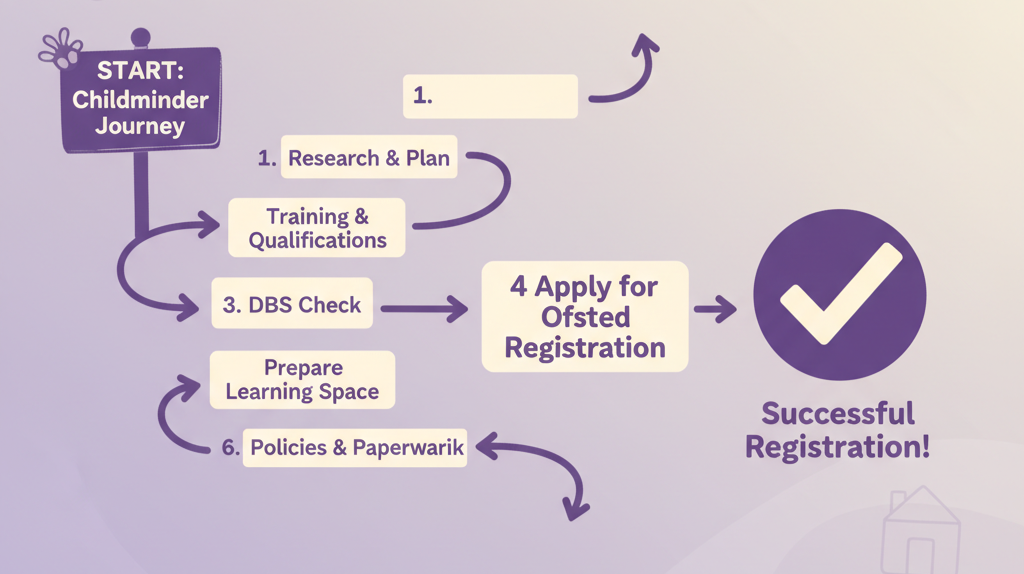
Why This Course is Your Essential Tool:
Saves Months of Guesswork: Get clear, beginner-friendly guidance with no jargon, so you know exactly what to do and in what order.
Avoids Costly Mistakes: Set up correctly from the very start, avoiding common pitfalls that delay registration or cost you money.
Everything You Need: The course provides clear video lessons, written guides, essential checklists, and editable templates for your policies and contracts.
Proven Support: Built by professionals who’ve opened nurseries and successfully registered multiple childminders, giving you real inspection examples.
Affordable Investment: For a single, one-time payment of £49.00, you get lifetime access and save hundreds in potential agency fees by learning to register directly.
By the end of this course, you will not only know exactly how to register with confidence but also be ready to run your business professionally and profitably.
Ready to take the confusion out of registration?
Not Ready to Enrol Yet? Get Your Free Childminder Startup Guide
We understand that becoming a childminder is a big decision, and you might need a little more clarity before investing.
Download our FREE Childminder Startup Checklist to get a head start on planning your business and preparing your home.
Inside, you’ll get:
The 3 Essential Steps you can take today without spending a penny.
A breakdown of the initial costs to expect.
A summary of the required space and equipment.
This is the perfect next step for anyone in the planning stage.