
The Childminder’s Essential Guide to Contracts, Payments, and Late Fees
Setting Professional Boundaries

The work of a childminder is deeply personal, often blurring the lines between home and professional life. However, treating your childminding service as a robust business is essential for sustainability, compliance, and mental well-being. The single most important document in setting professional boundaries is your Parent Contract.
A well-drafted contract isn’t a sign of mistrust; it is the foundation of a strong, transparent parent partnership. It serves as a clear, legally sound reference point that protects both you, as the provider, and the families you serve.
This in-depth guide will walk you through creating a watertight contract, managing complex payment scenarios like bank holidays and sickness, and implementing a fair but firm late collection policy.
The Anatomy of a Watertight Childminder Contract
Your contract is more than just a piece of paper; it is a detailed declaration of the service you provide and the expectations for payment. While you can find excellent starting points and childminder contract template resources from professional bodies like PACEY (Professional Association for Childcare and Early Years), tailoring it to your unique setting is crucial.
For official guidance on contracts and legal requirements for self-employed individuals, always refer to the government advice on GOV.UK: GOV.UK: Working for Yourself
1. The Core Legal Requirements
As a self-employed business owner, your contract with parents is a legally binding service agreement. Although you are not an employer, you are bound by consumer rights legislation.
Essential components that must be clearly stated:
Identities and Registration: Full names, addresses, and contact details for both the childminder (including your Ofsted registration number) and the parents.
Child’s Details: The full name and date of birth of the child being cared for.
The Service Provided: Exact days and hours of attendance, including drop-off and collection times, and the agreed hourly/daily/weekly rate.
Commencement Date: The date the contract comes into force.
Beyond these basics, you must clearly document policies that govern the financial and operational reality of your business. If a situation is not covered in the contract, you have no clear ground to stand on when issues arise.
2. Clarity on Working Hours and Ratios
The contract must clearly state the hours the child is contracted for, distinguishing between fixed hours and any pre-agreed flexibility (which should incur an additional fee).
It’s also wise to include a clause stating that all care is provided in strict adherence to your Ofsted registration conditions and the statutory ratio requirements. This is a powerful boundary. If a parent habitually requests extra hours that would compromise your legal capacity, you can refer them directly to this clause.
Mastering the Childminder Payment Policy
Financial uncertainty is the number one cause of stress for childminders. A clear childminder payment policy provides peace of mind and ensures consistent cash flow.
Payment Frequency and Terms
Payments should always be managed in advance. This treats your service like any other utility (like a mobile phone contract or a gym membership) where payment secures the service for the upcoming period.
Frequency: Specify whether you require payments weekly or monthly. Monthly payments are often preferred by parents (aligning with salaried incomes) but require you to calculate the monthly average accurately (weekly rate x 52 weeks / 12 months).
Due Date: State the exact day payment is due. For example: “Fees are due by 5 PM every Friday for the following week’s care,” or “Monthly fees are due on the 1st of the month.”
Method: Specify acceptable payment methods (e.g., bank transfer, Tax-Free Childcare scheme, vouchers).
💡 Business Tip: Consistent financial tracking is key to knowing if you are being paid correctly. Make sure you log every payment and reconcile it with your expenses. We recommend utilizing a dedicated resource like our Childminder Expense Tracker to manage all incoming fees and outgoing costs efficiently.
Dealing with Absence: Sickness and Holidays
This section must be crystal clear. The general rule in childminding is: You charge to retain the place, regardless of attendance.
Child’s Sickness: Full fees are payable. Your operating costs (rent, utilities, insurance, preparation time) remain the same whether the child attends or not.
Childminder’s Sickness: Policies vary. Many childminders offer one or two days of care free of charge per year, after which full fees are payable. A more common and simpler approach is to charge no fee for the period you are closed due to illness.
Parent’s Holidays: Full fees are payable. You are holding the child’s guaranteed space during their absence.
Childminder’s Holidays: You must specify how many weeks per year you take (e.g., four weeks) and whether these weeks are charged at full, half, or zero rate. Charging zero or half rate is common and often seen as a fair compromise, but be sure to budget for this lost income.
The Bank Holiday Conundrum
This is a recurring financial query for new childminders. The simplest, most professional answer to how to charge for bank holidays childminder is to state in the contract that Bank Holidays are charged at your full rate as they are considered one of your regular operating days, even if the service is not provided.
Why? Your fee structure is based on annual costs divided by 12 months. Charging for Bank Holidays ensures your income is consistent across the year, and you are not financially penalised for national closures. If you decide not to charge, you are effectively taking a significant pay cut.
Example Clause: “Statutory UK Bank Holidays fall within the standard operating hours of the contract and are charged at the full contracted rate.”
Handling the Hard Conversations: Arrears and Notice Periods
A strong contract empowers you to manage non-payment and terminations professionally, avoiding awkward confrontations.
Policy on Fees in Arrears
An arrear is when a payment is late. Your policy should outline a graduated response:
Initial Contact (Day 1-2 Late): A polite reminder (email/text) noting the payment is overdue.
Formal Warning (Day 3-5 Late): A formal written notice stating that if payment is not received within a set number of days (e.g., 5 working days), the contract will be temporarily suspended, and the child’s place will be withdrawn.
Contract Suspension/Termination: Clearly state the date care will cease if the payment is still not received. This is a crucial line: you cannot be expected to provide care for free. You must also include a clause that any costs incurred in recovering the debt (e.g., collection agency fees) will be added to the outstanding balance.
Reputable organisations like PACEY offer contract templates and advice specifically tailored to the childminding sector, which can help ensure your legal language is sound: PACEY Childminding Information
Clear and Fair Notice Periods
A notice period protects your income, allowing you time to find a replacement child when a family leaves.
Standard Notice: The industry standard is four weeks (28 days) written notice from the parent. This ensures your business remains viable.
Notice Period Calculation: Specify that the notice period must be given in writing, dated from the day it is received, and that full fees are payable throughout the notice period, regardless of whether the child attends.
Childminder-Initiated Termination: Your contract must also include clauses allowing you to terminate the contract, usually with the same four weeks’ notice, but also an immediate termination clause for severe breaches, such as:
Non-payment of fees.
Persistent late collection.
Repeated failure to adhere to policies (e.g., bringing a clearly sick child).
Any action that jeopardises the safety or well-being of the other children in your care.
Implementing the Late Fee Policy: Fair, Firm, and Focused
Late collection is frustrating, disruptive, and potentially dangerous as it can impact your ability to maintain legal ratios, especially if you have other contracted children arriving or being collected simultaneously. A mandatory, enforceable childminder late collection fee is not about profit—it is a deterrent to ensure respect for your time and the children’s routine.
1. Setting the Policy
The policy must be easy to understand and consistently applied.
The Grace Period: You might offer a one-time “grace” warning, or a very short, uncharged grace period (e.g., 5 minutes). Be careful with this; simplicity is often better.
The Fee Structure: Set a clear rate, calculated to be substantial enough to act as a genuine deterrent.
Per-Minute Rate: E.g., £1.00 per minute for every minute after the contracted collection time. This is easy to track and fair.
Tiered Rate: E.g., £10 flat fee for the first 15 minutes late, plus £1 per minute thereafter.
2. Legal Rationale
When discussing the late fee with parents, frame it in terms of compliance and staffing, not just personal inconvenience. A late collection may mean:
You are temporarily exceeding your legal ratio until the child is collected.
It impacts your family time and statutory working hours.
3. Consistency is Key
The moment you let one parent off the hook, the policy loses its integrity. Your contract must state that the late fee is immediately due upon collection and must be paid with the next invoice (or immediately, if preferred).
Example Clause: “In the event of late collection after the agreed time of [Time], a penalty fee of £1.00 per minute will be applied, starting from [Time + Grace Period, if applicable]. This fee must be settled immediately or added to the next invoice. Persistent late collection (more than three times in a six-month period) will be considered a breach of contract and may lead to termination.”
Conclusion: Making the Contract Your Strongest Business Asset
Creating these clear, professional boundaries transforms your service from an informal arrangement into a respected, structured business.
Do not be afraid to be firm on payment and policy. A parent who respects your contract is a respectful partner in their child’s care. By clearly outlining how you charge for sickness and how to charge for bank holidays, you safeguard your income, allowing you to focus completely on providing high-quality care.
We’ve covered the contractual framework here. Dive deeper into setting up as a childminder in our articles how to register as a childminder and a guide to the EYFS.
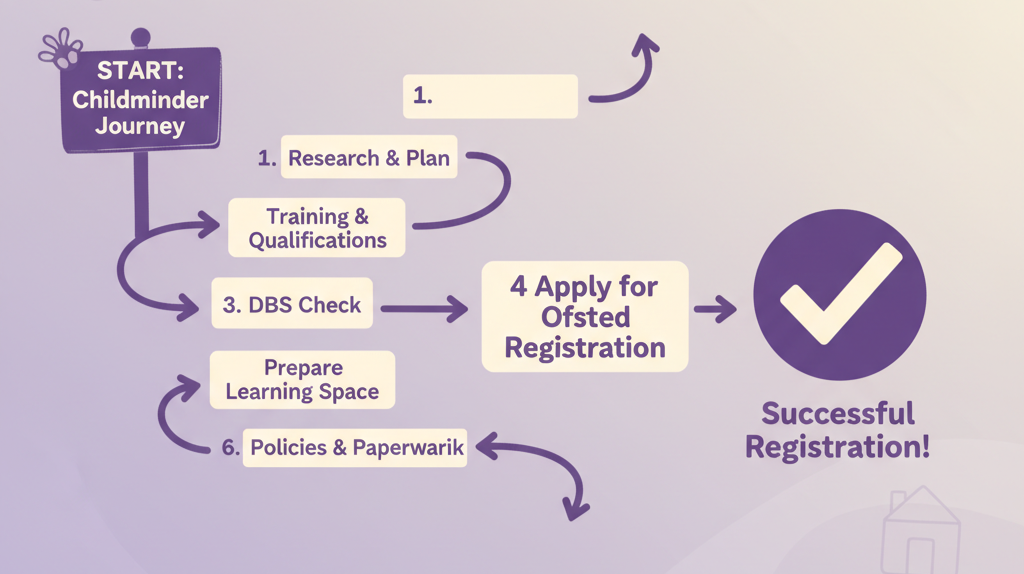
The Childminding Journey Made Simple: Your Step-by-Step Solution
 Navigating the necessary training, the endless forms, the complex language of Ofsted, and preparing for your home inspection can often feel like a massive undertaking. You shouldn’t have to piece together scattered advice from Facebook groups or spend months guessing what to do next.
This is exactly why we created the Become a Registered Childminder in the UK – Step-by-Step course.
It’s the complete roadmap – everything you need to go from idea to fully registered childminder and beyond.
Why This Course is Your Essential Tool:
Saves Months of Guesswork: Get clear, beginner-friendly guidance with no jargon, so you know exactly what to do and in what order.
Avoids Costly Mistakes: Set up correctly from the very start, avoiding common pitfalls that delay registration or cost you money.
Everything You Need: The course provides clear video lessons, written guides, essential checklists, and editable templates for your policies and contracts.
Proven Support: Built by professionals who’ve opened nurseries and successfully registered multiple childminders, giving you real inspection examples.
Affordable Investment: For a single, one-time payment of £49.00, you get lifetime access and save hundreds in potential agency fees by learning to register directly.
By the end of this course, you will not only know exactly how to register with confidence but also be ready to run your business professionally and profitably.
Ready to take the confusion out of registration?
Not Ready to Enrol Yet? Get Your Free Childminder Startup Guide
We understand that becoming a childminder is a big decision, and you might need a little more clarity before investing.
Download our FREE Childminder Startup Checklist to get a head start on planning your business and preparing your home.
Inside, you’ll get:
The 3 Essential Steps you can take today without spending a penny.
A breakdown of the initial costs to expect.
A summary of the required space and equipment.
This is the perfect next step for anyone in the planning stage.