The landscape of Early Years inspections has undergone a seismic shift. While the framework has evolved, the grading language has changed, and the very way evidence is gathered has been transformed, many settings are still operating on “autopilot” using old habits.
Under the current inspection framework, these legacy habits aren’t just outdated—they are far more visible to inspectors than they used to be. The reality is that the worst time to realise your practice needs an upgrade is during the inspection itself. As I often say on my YouTube Channel, growth doesn’t start with perfection; it starts with awareness.
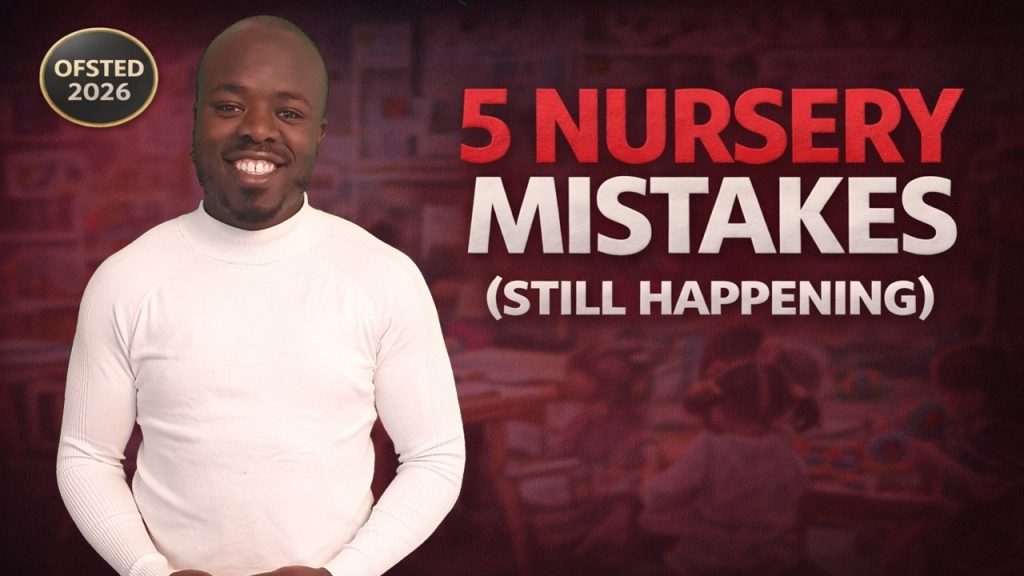
Based on observations across the UK, here are the five biggest mistakes nurseries are still making and, more importantly, the strategic shifts required to fix them.
1. Prioritising Paperwork Over Practice
For years, the “gold standard” in many nurseries was the thickness of the planning folder or the beauty of a tracking spreadsheet. However, the new framework has flipped this script. One of the most common mistakes is still focusing on high-volume documentation rather than high-impact practice.
The Risk: Inspectors are now far more focused on impact than volume. If your practitioners are spending more time writing about learning than they are actually interacting with children, it triggers a red flag. Beautiful learning journals are useless if the staff cannot explain how those journals inform what happens in the room.
The Correction:
Simplify: Reduce unnecessary paperwork where possible. If you are struggling with this, our Nursery Documents package provides streamlined templates that satisfy regulations without the fluff.
Focus on Dialogue: The new approach leans heavily on professional dialogue.
Ask the “Why”: Ensure staff can clearly explain how their planning changes the daily experience for the child.
In the eyes of an inspector, impact will always outweigh paperwork.
2. Weak Curriculum Articulation
There is a massive difference between “doing activities” and “delivering a curriculum”. Many settings are incredibly busy—they follow interests, celebrate festivals, and plan themes—but they stumble when asked to articulate the why behind it. This is often the difference between a “Good” and an “Outstanding” (or “Exceptional”) grade.
The Risk: When an inspector asks, “What comes next?” or “How does this build over time?” and meets hesitation, that hesitation is where risk sits. Curriculum is about progression and sequencing. Without clarity, a setting is likely to be capped at “Expected” rather than reaching for “Strong”.
The Correction: Staff must move beyond understanding the activity to understanding the purpose and progression. You can find deeper guidance on this in our Complete Nursery Guide Course.
Encourage staff to use “link language,” such as:
“Last week we introduced this concept, and today we are building on it by…”
“For this specific child, we’ve adapted the environment because…”
3. Favouring Control Over Support in Behaviour Management
This is a sensitive but vital area. On the surface, a room might look perfect: children are sitting quietly and following instructions. However, if that calm is built on a foundation of fear, sanctions, or an over-reliance on reward charts, it is considered “fragile” under the new framework.
The Risk: The current framework places a much heavier weight on emotional wellbeing and literacy. Inspectors are looking to see if regulation is co-created or simply demanded. Public corrections or compliance-based language (like “because I said so”) are signs of a setting that values suppression over support.
The Correction: Exceptional settings focus on co-regulation. This requires adults to model calm and understand child development—recognising that a three-year-old’s impulse control is still developing. If you want to see how your team measures up, a Mock Ofsted Registration Visit can provide an honest, external perspective on your room’s emotional climate.
4. Misunderstanding the New 5-Point Scale
Many nursery leaders are still operating mentally under the old binary. The shift to a nuanced scale—specifically the categories of Expected, Strong, and Exceptional—is a sharpening of expectations.
The Risk: There is a frequent “calibration issue” where settings believe they are “Strong,” but because their leadership clarity is vague, they are actually sitting at “Expected”. If your answers to an inspector’s questions are vague, your outcome will be limited.
The Correction: Honest self-evaluation is essential. You must be able to answer:
For those in the pre-opening phase, starting with our Free Starter Guide is the best way to understand these benchmarks from day one.
5. Leadership Not Driving the Improvement Journey
The final mistake occurs when leadership is reactive rather than proactive. If you only look at your quality of practice when an inspection is “due,” you have already missed the window for meaningful improvement.
The Risk: If supervisions only focus on rotas and ratios (though you should definitely use our Nursery Ratio Calculator to stay compliant), and not on practice, leadership isn’t driving improvement.
The Correction: Strong settings do not claim to be perfect; they claim to be reflective.
Conclusion: The Shift Toward Reflection
Moving from “Expected” to “Exceptional” doesn’t require perfection—it requires clarity and intention. The strongest settings under the new framework are those that have fostered a reflective culture. When something isn’t working, they don’t defend it; they adjust it.
Identifying these gaps now, rather than during your inspection, is the healthiest place to be. As you prepare, remember that you are not alone in this journey. Join our Facebook Group for Successful Early Years Owners to connect with others navigating the same challenges.
Are you ready to audit your setting against these five points? Identifying your blind spots today is the first step toward a confident inspection tomorrow.
Take the Next Step in Your Journey

 Go From Nursery Worker to Nursery Owner In Just 6 Months