
Early Years SEND Funding Update
New £47m Inclusive Early Years SEND Fund: What Nurseries Need to Know
A new £47 million fund is being distributed to early years providers across England to help settings strengthen inclusive practice and provide earlier support for children with special educational needs and disabilities.
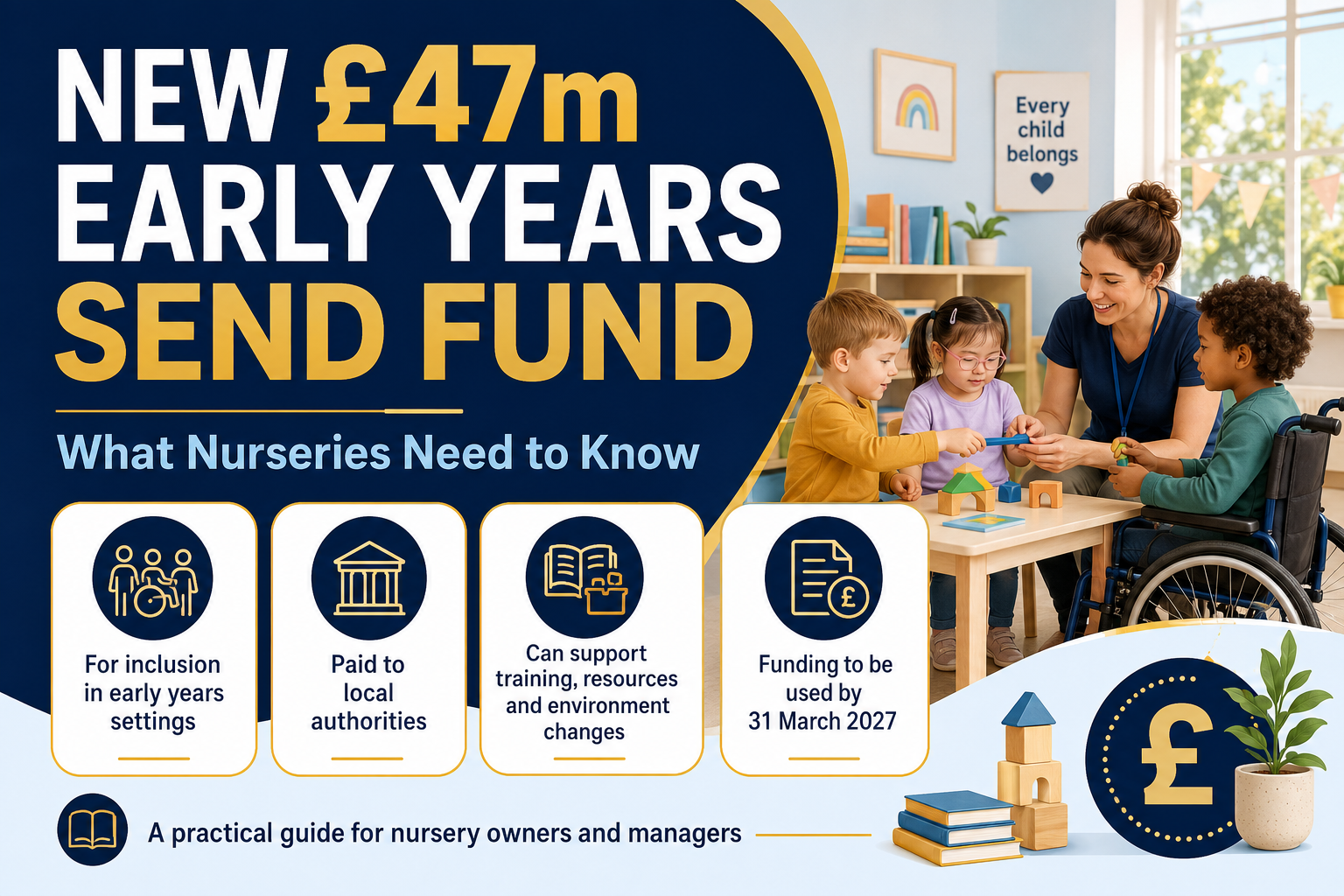
The Inclusive Early Years Fund is intended to help providers strengthen whole-setting inclusive practice.
The new Inclusive Early Years Fund, often shortened to IEYF, works differently from many existing SEND funding streams. Providers should not have to submit an application for an individual child before receiving the funding. Instead, local authorities must distribute the money upfront using a formula-based approach so that settings can plan improvements to inclusive practice.
Additional national funding for the early years sector in 2026 to 2027.
DfE’s recommended minimum meaningful allocation where a setting receives the fund.
The funding must be distributed without a panel or individual-child application process.
Deadline by which providers should have spent their allocation.
What is the Inclusive Early Years Fund?
The Inclusive Early Years Fund is a new Department for Education funding stream for the 2026 to 2027 financial year.
Local authorities receive the money from the DfE and must distribute it to eligible early years providers using a formula-based approach.
The purpose is to help settings strengthen inclusive practice across their provision rather than waiting until a child has an identified need and then applying for support individually.
The fund is intended to encourage earlier intervention and help settings prepare for the range of additional needs they may encounter across their cohort.
Who can receive the funding?
Local authorities can only use the fund for early years providers that deliver the Government’s free early years entitlements.
This can include nurseries, pre-schools, childminders and other eligible early years settings.
However, being eligible does not automatically mean that your setting will receive an allocation.
Local authorities are allowed to use their own formula to target SEND need locally, provided it meets the DfE’s conditions. They may also apply a minimum funding threshold.
This means some smaller providers and childminders may not receive a direct allocation if the amount calculated for them would be too small to create what the DfE considers a meaningful improvement.
How much might your nursery receive?
There is no single national amount that every nursery will receive.
The DfE recommends that local authorities design their allocation method so that settings receiving funding get an amount large enough to make a meaningful difference.
Its recommended approach includes:
- a base allocation for eligible settings;
- an additional needs or deprivation element;
- a minimum funding threshold expected to be around £1,000 per setting.
Local authorities can choose a different local formula, so actual payments are likely to vary across England.
Nursery owners should therefore check the arrangements published by their own local authority rather than assuming they will automatically receive £1,000.
What can nurseries spend the funding on?
The important principle is that IEYF should strengthen inclusive practice across the setting rather than simply paying for ordinary operating costs.
Changing the environment
Settings may use the funding to make improvements to the physical environment that help children with additional needs access provision more successfully.
Staff training and development
Funding can support staff release for relevant training and professional development that strengthens inclusive practice.
Adapting the curriculum
Providers can make changes to curriculum delivery so that more children can access meaningful learning and participation.
Group interventions
The fund can help settings introduce interventions for groups of children with commonly occurring or emerging needs.
Inclusive resources
Appropriate resources may be purchased where they form part of a clear plan to improve inclusive practice across the setting.
Setting-wide improvements
The fund is intended to support strategic improvements that help the setting meet current and emerging needs more effectively.
What is the difference between IEYF, SENIF and DAF?
One of the easiest mistakes to make is assuming that the new fund replaces existing SEND funding. It does not.
| Funding | Main purpose | How it differs |
|---|---|---|
| IEYF | Strengthen whole-setting inclusive practice. | Upfront funding that is not tied to one individual child. |
| SENIF | Additional targeted support for children or groups with SEN. | Local eligibility and application arrangements vary between local authorities. |
| DAF | Help eligible disabled children access funded early education. | Linked to children receiving Disability Living Allowance and accessing funded entitlements. |
| High needs funding | Support children with more significant or complex additional needs. | Usually provides more targeted higher-level support. |
Why does the funding work differently?
Traditional SEND funding can sometimes mean that settings wait until needs have become significant before funding is available.
It can also create large differences between local authorities because application systems, evidence requirements and eligibility criteria vary.
IEYF is intended to move some support earlier in the process. Instead of asking:
“Which individual child can we obtain funding for?”
the setting is encouraged to think more broadly about:
“What changes can we make now so our setting is better equipped to meet a wider range of needs?”
This is why the funding is not attached to one named child.
What evidence will nurseries need to keep?
Although providers do not have to complete an application to receive IEYF, they are still accountable for how the money is used.
The DfE says providers should retain financial evidence and be able to respond to reasonable requests for information from their local authority.
The evidence does not need to become an unnecessarily
complicated paperwork exercise. The guidance suggests that
proportion
Free Early Years Updates
Subscribe to receive new articles about Ofsted, the EYFS,
childcare funding, safeguarding and nursery business
directly in your inbox.
Enter your details below and you will receive an email when
a new important article is published.
Your information will be handled in accordance with our
Privacy Policy
.
You can unsubscribe at any time.
Keep up with important early years developments
Subscribe for free updates