
Baby Room Furniture and Equipment: What to Buy Before Opening
 By Curtly Ania6 minute readInformation checked: 14 October 2026
Buying baby-room equipment is about more than choosing matching furniture. This practical checklist helps you plan sleep, feeding, changing, play and storage around the children and the way your nursery will run.
Jump to a section
- Plan the room before filling a shopping basket
- Your opening checklist: essentials before extras
- Sleep furniture: practicality must support safer sleep
- Feeding furniture: choose for real use
- Changing, hygiene and everyday storage
- Play resources and floor space
- Compare the delivered and usable cost
- Curtly’s advice: buy for the first working day
- Common questions
- Sources and further reading
Plan the room before filling a shopping basket
Start with your intended ages, attendance, room dimensions and daily routines. Mark the routes between sleep, feeding, changing and play. Check doors, supervision sightlines and where adults need to work before choosing large items.
A baby room needs space for development and movement as well as equipment. A room filled with attractive furniture can be less useful than a simpler layout with clear circulation and practical storage. Buy for realistic opening numbers, while planning how the room could adapt later.
Write quantities against your operating plan. Do not use a generic equipment list to determine your permitted capacity or staffing; those need checking separately against your premises and current requirements.
Your opening checklist: essentials before extras
| Area | Plan before purchase | Check with the supplier |
|---|---|---|
| Sleep | Suitable individual sleeping arrangements and supervision | Age/size limits, mattress fit, care and replacement parts |
| Feeding | Age-appropriate seating and a workable cleaning routine | Stability, restraints where specified and cleaning instructions |
| Changing | Hygienic facilities, supplies and safe adult workflow | Intended use, installation, surfaces and weight limits |
| Play and movement | Clear floor space and suitable resources | Age suitability, small parts, cleaning and durability |
| Storage | Accessible daily supplies and secure restricted items | Fixing requirements, load limits and safe access |
On smaller screens, swipe across the table to see every column.
Keep décor and duplicate resources in a second phase. Protect the budget for essential items, correct installation and the smaller accessories needed to use them properly.
Sleep furniture: practicality must support safer sleep
Choose sleeping equipment that suits the children, has a correctly fitting mattress and can be maintained as instructed. The Lullaby Trust advises a firm, flat, waterproof mattress and a clear cot, without items such as pillows, soft toys, bumpers, pods or nests. Follow current safer-sleep guidance rather than a showroom arrangement.
The current England EYFS also sets out safer-sleep requirements, including clear cots and supervision. Babies under six months must have an adult in the same room for every sleep; sleeping children must remain within staff sight and hearing. Plan the layout around these requirements, not just the number of cots that physically fit.
Ask how equipment and bedding are cleaned, identified and stored. Check access for staff and manufacturer assembly instructions. A visually matching mattress is not enough: confirm it is the correct fit for that specific sleeping product.
Feeding furniture: choose for real use
Check age suitability, stability, the manufacturer’s restraint instructions where relevant and how comfortably staff can assist children. Ask whether surfaces, joints and seating components can be cleaned using your intended routine.
Consider storage and movement between meals. Folding or stackable designs may help space, but understand their mechanisms, safe use and where they will be kept. Include bibs, appropriate utensils and any replacement components in the budget.
Do not buy something labelled for children aged three and over for a baby room just because its style matches. Age limits and intended use need to be checked for the exact product, including accessories.
Changing, hygiene and everyday storage
Plan changing equipment around hygienic facilities, adult access and the supplies used repeatedly through the day. In England, the EYFS requires suitable hygienic changing facilities for children in nappies. Think through how staff reach clean supplies and handle used items without creating unnecessary crossings.
Ask about surface materials, cleaning instructions, installation and limits. Keep adult-only products securely inaccessible to children. Choose storage that separates individual belongings, clean supplies and equipment awaiting cleaning.
Check doors, drawers and shelving for pinch points, stability and fixing requirements. Arrange any required wall fixing with the appropriate installer and follow the manufacturer’s instructions. “Low” or “heavy” furniture is not a substitute for checking stability.
Play resources and floor space
Choose a manageable range of age-appropriate resources that support movement, exploration and interaction. Leave room for rolling, crawling and walking. Consider how resources are rotated so every available item does not have to be out at once.
Check small parts, accessible fastenings, material condition and cleaning requirements. Distinguish resources suitable for babies from products intended for older children. Supplier category labels are a starting point; read the exact item specification.
Use storage to make the room easy to reset. A practical room supports staff during busy transitions, not just during a carefully staged photograph. Check whether floor coverings and soft resources can be cleaned and maintained as intended.
Compare the delivered and usable cost
Ask for item prices plus delivery, assembly, fixing, accessories and tax treatment. Confirm access requirements and whether delivery means kerbside, inside the building or into the room. Measure the route through doors and corridors as well as the final space.
Check lead times, stock status, returns, warranty coverage and availability of replacement parts. A lower initial price can be less helpful if a damaged component cannot be replaced or an essential item arrives after opening.
For second-hand items, check history, condition, missing parts, instructions and any recalls before deciding they are suitable. Do not assume a used item is safe because it was previously in another nursery. Where suitability or history is uncertain, resolve it before use.
Curtly’s advice: buy for the first working day
I would walk through a normal day in the room before placing the main order. Where does a staff member prepare a feed, change a child, settle someone to sleep and put away a resource? Where are the other children during those routines?
Buy the essentials that make those movements work, then add further items once the room is operating. A coordinated finish is a bonus; age suitability, safe use, cleanability and a practical layout come first. Use the furniture directory to find suppliers, then ask for specifications for your shortlisted products.
Common questions
Do I need to buy everything before opening?
You need suitable equipment and resources for the provision you will actually offer. Separate opening essentials from optional additions, while leaving time for delivery, installation and checks.
Can I use preschool furniture in the baby room?
Only where the exact product is suitable for its intended users and use. Do not ignore a manufacturer’s age, weight or other restrictions.
Should the cot look like the hero image?
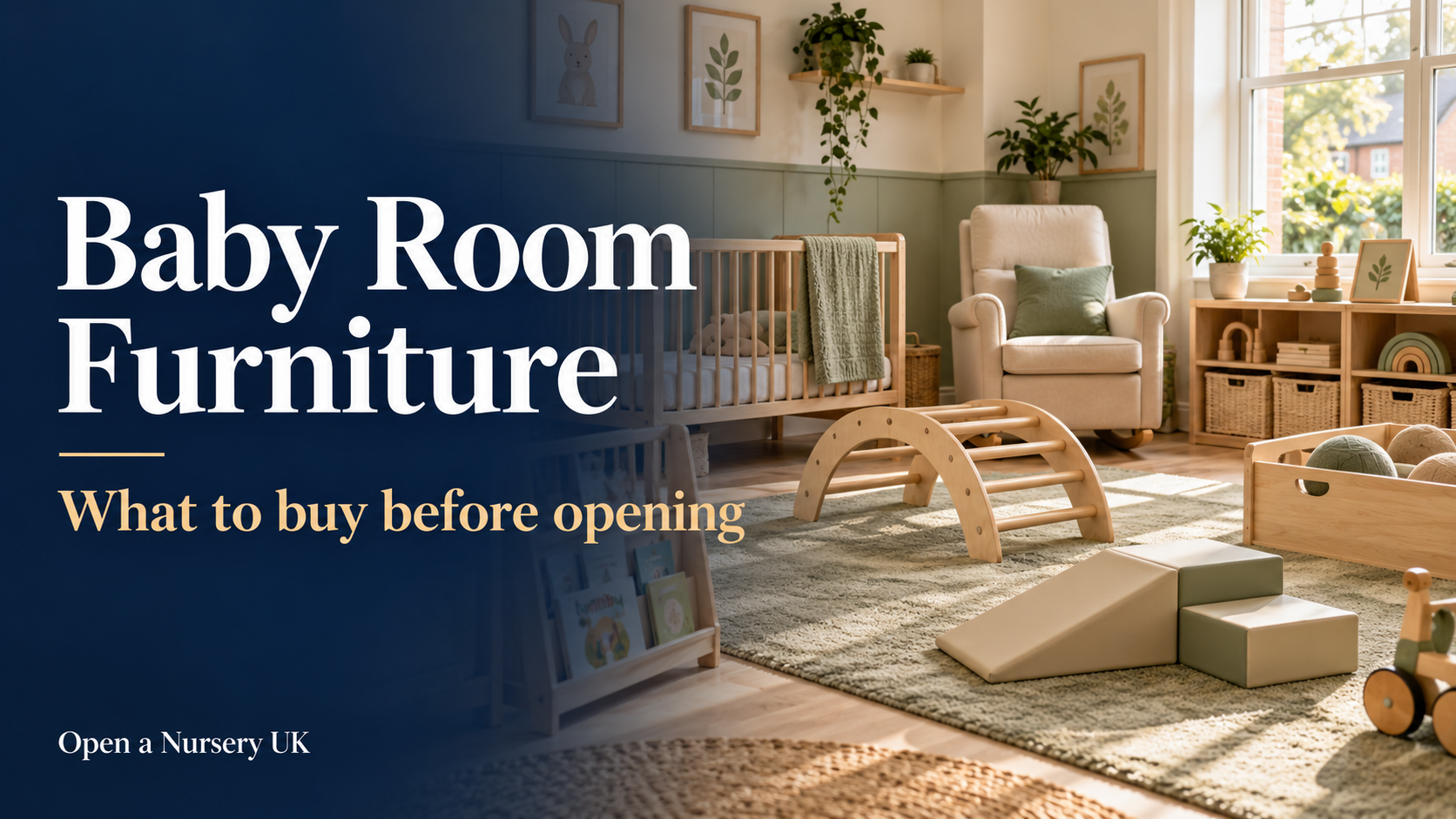
The image is illustrative. A cot used for sleep should follow current safer-sleep guidance, with unnecessary items removed. Decorative photographs are not setup instructions.
Sources and further reading
Sources checked 14 October 2026. Current EYFS framework · Lullaby Trust: keeping a clear cot · UK product recalls. Guidance referring to the EYFS applies to England; check the relevant framework for your nation. Supplier details and terms should be confirmed before ordering.
Find suppliers that suit your nursery.
Use the comparison directory to narrow your options, then confirm the details that matter to your nursery directly with the supplier.