
Early Years Funding Update
Early Years Funding Could Be Changing: What the DfE Proposals Mean for Nurseries
The Department for Education has opened a major consultation on how early years entitlement funding is calculated, distributed and passed on to childcare providers in England.
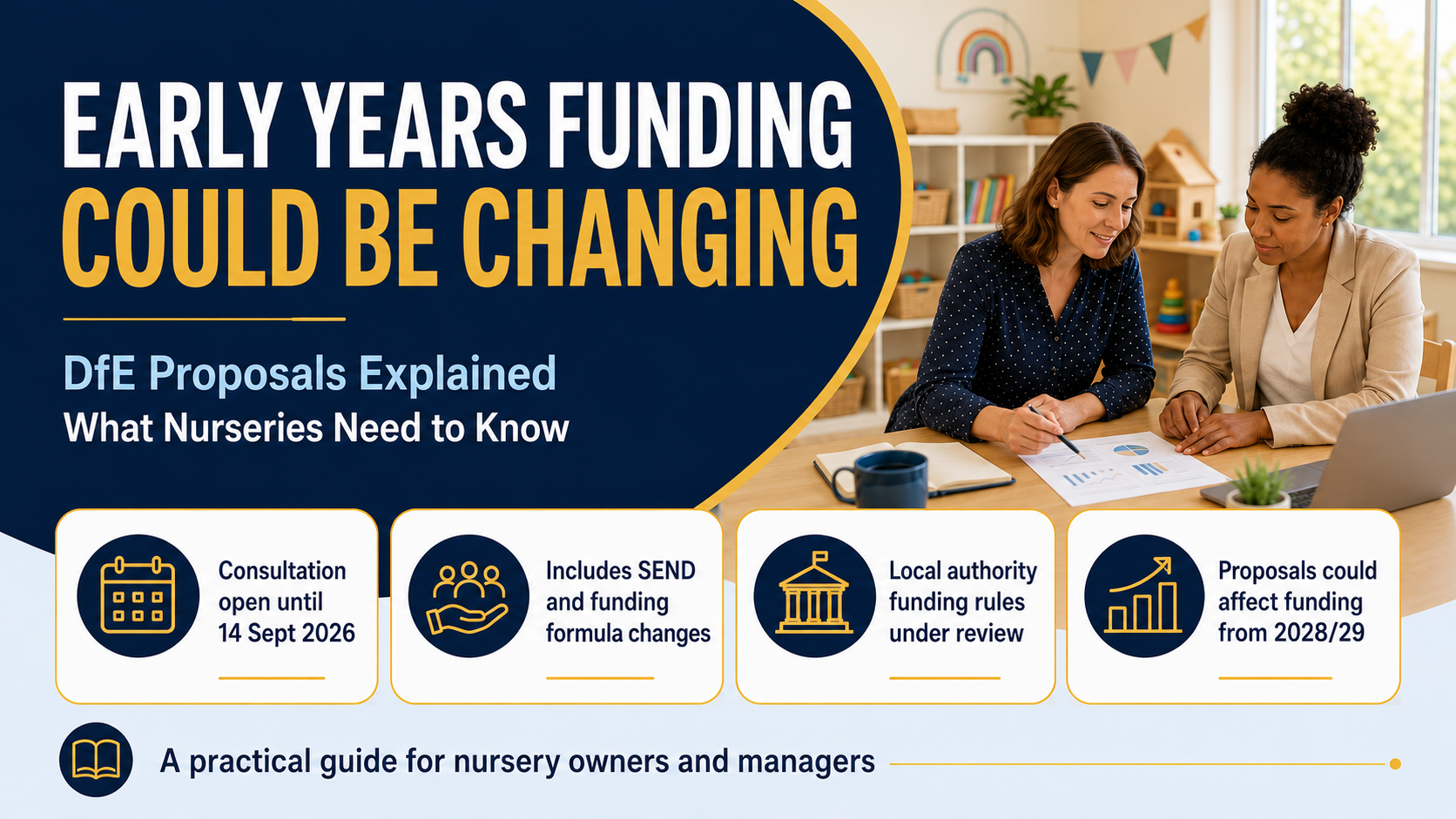
The DfE proposals cover SEND funding, national funding formula data and the rules local authorities use to distribute funding.
This consultation does not simply propose a small adjustment to hourly rates. It considers changes to SEND funding, deprivation funding, local authority deductions, contingency funds, funding supplements and Ofsted annual registration fees. The final reforms could affect how much funding reaches providers, what it is intended to pay for and what evidence nurseries may be expected to retain.
Date the early years funding consultation was published.
Closing date for providers and other interested parties to respond.
Proposed transition period for several initial funding changes.
Financial year in which the majority of the proposed reforms could begin.
Why is the early years funding system being reviewed?
The DfE says that early years entitlement funding arrangements have not been significantly updated since 2017.
The current system contains several funding streams, different local application processes and considerable variation between local authorities. Providers can receive different levels of support depending on where they operate, even where children have similar needs.
The Government now funds the majority of early education and childcare hours in England. The DfE therefore wants a system that is simpler, more transparent and better targeted towards disadvantaged children and children with SEND.
However, reforming the system could also change how funding is divided between local authorities and providers. That is why nursery owners should examine the detail rather than assuming every proposed change will automatically increase their income.
The main changes being considered
The consultation covers a large number of technical questions. The proposals below are among the most relevant for nursery owners, managers and childminders.
More upfront SEND inclusion funding
The DfE is considering a system where more funding is provided upfront to support setting-wide inclusive practice, rather than providers relying as heavily on applications linked to individual children.
A suggested minimum spend on SENIF
As an interim measure for 2027 to 2028, the DfE proposes recommending that local authorities spend at least 0.75% of their early years block on SEN Inclusion Funding.
More funding passed on for eligible two-year-olds
Local authorities could be expected to pass more of the Early Learning for 2s funding rate directly to providers, rather than retaining part of it for central spending.
Updates to the national funding formula
The DfE plans to use more recent labour-market data and new deprivation data when calculating local authority rates from 2027 to 2028.
Changes to local funding supplements
The number and type of supplements local authorities can use may be reduced, with deprivation, inclusion and site-specific funding becoming the main categories.
Unused contingency funding could reach providers
Local authorities may be allowed to redistribute unused early years contingency funding to providers during the financial year.
Central services could be funded separately
The consultation considers separating local authority central service funding from the funding allocated for provider hourly rates.
Ofsted annual fees could be reduced or removed
Some Ofsted Early Years Register costs could instead be funded through a small deduction from the national entitlement budget.
How could SEND funding change?
The existing early years SEND system includes several separate funding streams, including SEN Inclusion Funding, the Disability Access Fund and high needs funding.
Eligibility criteria, application processes and payment arrangements vary significantly between local authorities. Providers often report delays in receiving support, particularly where funding is linked to individual applications or a formal diagnosis.
The proposed direction is towards a layered system. Settings could receive upfront inclusion funding to strengthen inclusive practice for all children, alongside targeted funding for children who need additional or more specialist support.
For 2027 to 2028, the £47 million Inclusive Early Years Fund is expected to remain a separate grant. From 2028 to 2029, the DfE proposes building upfront inclusion funding into the rates paid to local authorities.
The consultation also proposes replacing SENIF and the Disability Access Fund with a more streamlined targeted funding stream. The precise eligibility rules and local distribution arrangements have not yet been decided.
Greater funding could bring greater accountability
Providers may be expected to demonstrate how inclusion funding has been used to improve practice and support children.
The consultation suggests that access to future inclusion funding could be restricted where there is insufficient evidence that it has been used appropriately, or where a setting unreasonably restricts access for children with additional needs.
How could the national funding formula change?
The Early Years National Funding Formula is used to calculate the hourly rates paid by the DfE to each local authority.
The formula attempts to reflect local delivery costs and levels of need. The DfE intends to update two important sources of information from 2027 to 2028.
Updated labour-cost data
The workforce-cost data currently used in parts of the formula dates back to 2013 to 2014. New labour-market data would give each local authority a more current and specific estimate of local staffing costs.
This could increase relative funding in some areas and reduce it in others. The consultation therefore asks how transitional protection should be used to manage significant changes.
New deprivation data
The DfE proposes adding the Income Deprivation Affecting Children Index to the funding formula for three and four-year-olds.
The existing deprivation element has an 8% weighting based on free-school-meal data. Under the proposal, the overall weighting would remain at 8%, but would be split equally: 4% based on free-school-meal data and 4% based on the deprivation index.
Could more local authority funding reach providers?
Local authorities currently have to pass through at least 97% of early years entitlement funding to providers. They may retain up to 3% for central services.
Providers have repeatedly raised concerns about the gap between the hourly rates published nationally and the rates they ultimately receive locally.
The DfE is considering separating central-service funding from provider funding through a standalone grant. This could make it clearer how much money is intended for settings and how much is being used for local administration and support services.
It does not necessarily mean that every penny currently retained would automatically be added to provider rates. Some local authorities use central funds for important services, including SEND support, administration and provider advice.
What could happen to unused contingency funding?
Local authorities retain contingency funding to manage changes in the number of children taking up funded places during the year.
Current rules make it difficult for local authorities to redistribute unused contingency money to providers within the same financial year.
From 2027 to 2028, the DfE proposes allowing local authorities to distribute identified underspends through a transparent method, such as a one-off increase or percentage top-up to provider rates.
This could help ensure that early years funding remains in the sector rather than being used to offset wider Dedicated Schools Grant pressures.
What could happen to local funding supplements?
Local authorities can currently distribute part of provider funding through several different supplements. These can include deprivation, quality, flexibility, rurality and English as an additional language.
From 2028 to 2029, the DfE proposes reducing the permitted categories to:
- deprivation funding;
- a new inclusion supplement;
- a site-specific supplement covering local issues such as workforce pressures or rurality.
English as an additional language would no longer remain a separate category, although local authorities could continue supporting this through the proposed inclusion supplement.
Could Ofsted annual registration fees be removed?
Providers on the Early Years Register currently pay an application fee and an annual registration fee to Ofsted.
The DfE is testing the principle of reducing or removing annual fees and funding some Ofsted Early Years Register costs through a small national deduction from early years entitlement funding.
The consultation estimates that the effect on national average local authority rates would be no more than a few pence. Providers would partly offset this because they would no longer pay, or would pay a reduced, annual fee.
Initial application fees would still remain payable. Childminder agency fees would also be unaffected because those fees are not set by the Government.
Proposed timeline
-
14 September 2026
Consultation closes
Final date for providers, local authorities, parents and other interested parties to submit responses.
-
Autumn 2026
Government response expected
The DfE intends to publish the consultation findings and its response.
-
2027 to 2028
Initial and transitional changes
These could include updated formula data, the suggested SENIF minimum and allowing unused contingency funds to be redistributed.
-
2028 to 2029
Major reforms could begin
Proposed changes include new SEND funding streams, reduced supplement categories and further changes to local funding rules.
-
From 2029 to 2030
Further funding rebalancing
The DfE proposes considering whether a greater share of high needs funding should reach early years settings upfront.
What could these changes mean for nursery owners?
Funding could become more transparent
Separating local authority central costs from provider funding could make it easier to understand why locally paid rates differ from national rates.
SEND support could arrive earlier
More upfront funding could allow settings to improve inclusive practice before a child receives a formal diagnosis or individual funding decision.
Record keeping may become more important
Settings may need stronger evidence showing how SEND funding has been spent and how it has improved provision.
Some local areas could gain or lose funding
Updated labour-cost and deprivation data could redistribute national funding between local authorities.
Local formulas may become less flexible
Reducing the number of supplements could increase consistency but may also remove arrangements that currently address particular local pressures.
More unused funding may reach settings
The contingency proposal could allow local authorities to make additional payments where underspends emerge.
What nursery owners should do now
The proposals are not yet final. Providers have an opportunity to explain how the current system works in practice and where changes could help or create unintended consequences.
- Compare your local hourly rates with the national rates published for your local authority.
- Record delays, barriers and administration involved in applying for SEND funding.
- Review how your nursery currently uses SENIF, DAF, deprivation supplements and Early Years Pupil Premium.
- Identify any central services your local authority provides that would be affected by separate funding.
- Consider whether the proposed accountability requirements would create additional workload.
- Submit practical examples and financial evidence before the consultation closes.
Official sources
This article is based on the Department for Education consultation published on 6 July 2026.
This article provides general information and commentary for early years providers. The proposals remain subject to consultation and may be amended, delayed or withdrawn. Providers should check the latest official guidance before making financial or operational decisions.
Free Early Years Updates
Keep up with important early years developments
Subscribe to receive new articles about Ofsted, the EYFS, childcare funding, safeguarding and nursery business directly in your inbox.
- Important Ofsted and inspection updates
- EYFS and childcare policy changes
- Funding and nursery business news
- Clear explanations of what changes mean
Subscribe for free updates
Enter your details below and you will receive an email when a new important article is published.
Your information will be handled in accordance with our Privacy Policy . You can unsubscribe at any time.