
Opening a nursery franchise: is it the right route for you?
A nursery franchise can give you a recognised brand, systems and a ready-made business framework. An independent nursery gives you greater control over the brand, the operation and the long-term value you build. This guide explains the real trade-offs so you can make the decision with your eyes open.

Is a nursery franchise automatically safer than opening independently?
No. A good franchise may reduce some of the guesswork by giving you established systems, training and brand support. But you are still making a major commercial decision and the nursery still has to be financially viable, appropriately staffed, suitable for registration and well run.
A franchise buys you a system. It does not remove your responsibility as an owner.
Whether you open through a franchise or under your own brand, the childcare provision itself must meet the registration and regulatory requirements that apply to it. In England, providers on the Early Years Register must meet the current EYFS statutory requirements. A franchise can help organise the journey, but it cannot replace your own due diligence, leadership or regulatory responsibility.
Official references: Ofsted childcare registration guidance and the current EYFS statutory framework.
What is a nursery franchise?
In a business-format franchise, the franchisor owns an established brand and operating system, while the franchisee is given the right to trade using that brand and system under a franchise agreement. You are not simply buying a logo. You are entering a commercial relationship that normally covers how you can use the name, how the setting should operate, what support you receive, what you must pay and what happens if you later renew, sell or leave.
That distinction matters. A nursery chain and a nursery franchise are not automatically the same thing. Some childcare groups own and operate their settings directly. Others allow independent franchisees to open sites under their brand. If you are researching a particular nursery company, always check whether it is currently offering a genuine franchise opportunity rather than assuming that every multi-site childcare brand operates through franchising.
The exact package differs from one franchisor to another, but a nursery franchise may include use of the brand, initial owner training, an operations manual, help with property criteria, design standards, procurement guidance, marketing assets, software, curriculum or practice frameworks, recruitment systems and ongoing business support.
In return, the franchisee normally agrees to operate within the franchisor’s model. That can affect branding, suppliers, room presentation, marketing, technology, reporting, promotions and other operational decisions. The extent of that control is one of the most important things to understand before you invest.
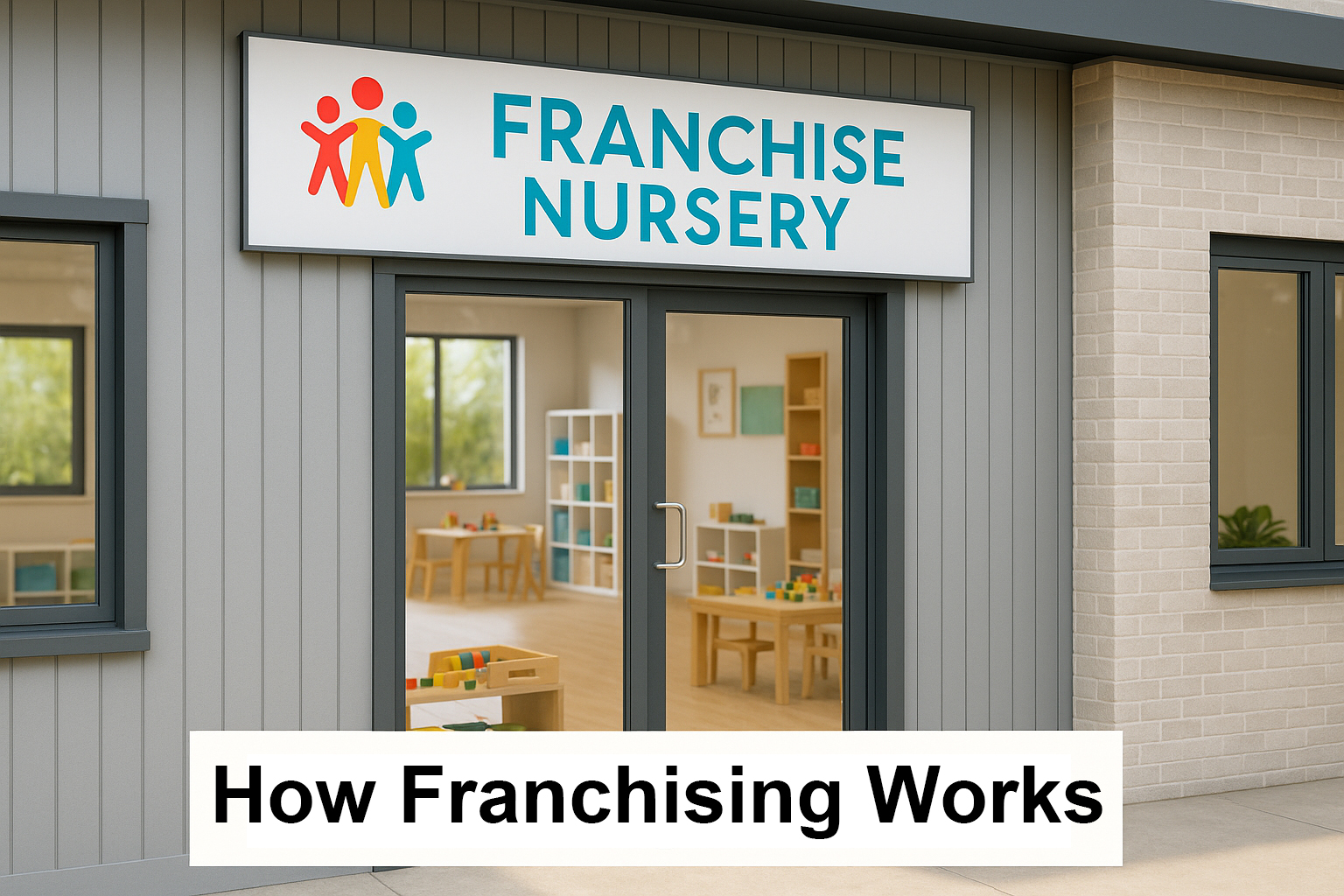
HMRC describes a franchise as an existing business allowing a third party to trade using its branding or business model in exchange for a fee. The British Franchise Association similarly describes franchising as a relationship in which the franchisee trades under the franchisor’s brand through a franchise agreement.
Read: HMRC’s franchise overview and British Franchise Association guidance.
The franchise agreement is central
It is easy to get excited by a polished brochure, a nursery tour or a projected turnover figure. But the agreement is where the commercial relationship becomes real. It should set out the respective rights and obligations of the parties and will normally deal with matters such as payment obligations, duration, renewal, training, termination and resale.
This is why I would never suggest choosing a nursery franchise from the brochure alone. You need to understand the contract you are actually agreeing to. The BFA advises prospective franchisees to carry out due diligence, speak with existing franchisees and have the franchise agreement checked by a specialist franchise lawyer.
The franchise fee is only the beginning
Do not compare franchise opportunities using the headline fee alone. The number that matters is the total amount of capital you need to reach opening and survive the early trading period.
Initial franchise payment
This is normally the price for joining the system and obtaining the rights and initial package described by the franchisor. Check whether VAT is additional and exactly what is included.
Nursery setup investment
You may still need significant capital for the property, deposits, professional fees, planning work, refurbishment, furniture, resources, technology, recruitment, pre-opening payroll and launch marketing.
Ongoing franchise costs
Depending on the agreement, there may be royalties, management service fees, marketing levies, software charges, required purchases, renewal costs or other ongoing payments.
Why I have not put a generic “nursery franchise costs £X” figure here
Because it can be misleading. Nursery franchise models vary enormously in property type, size, fit-out standard, territory, brand positioning and the amount of capital they expect a franchisee to have. The current published investment required by one franchise can be very different from another.
There is also a difference between a franchise fee, the minimum liquid capital a franchisor wants you to demonstrate and the total project cost of opening the nursery. Treat those as separate figures. If a prospectus tells you the franchise fee but does not give you a realistic picture of property, fit-out, working capital and pre-opening costs, you do not yet know the real investment.
Working capital matters as much as the opening budget
A beautiful nursery is not financially safe simply because the building work is finished. You need enough cash to operate while enrolment grows. Salaries, rent, utilities, insurance, food, software, marketing and other costs start arriving before the nursery necessarily reaches its planned occupancy.
When assessing any franchise projection, look at the assumptions behind it. How quickly does it expect occupancy to build? What fee levels does it assume? What staffing structure is built into the numbers? Does the projection include debt repayments? Does it include every franchisor charge? How sensitive is the model if you open later than planned or recruit more staff than expected?
A franchise can give you a financial model. It cannot make weak assumptions become safe assumptions. You still need to understand the numbers.
What a good nursery franchise can give you
The strongest argument for franchising is not the name on the sign. It is the combination of brand, systems, experience and support that sits behind it.
Brand and positioning
You begin with an established identity rather than creating a brand from scratch. Depending on the franchise, that may help with parent recognition, marketing consistency and launch materials.
Operating systems
A mature franchise should already have documented processes for major parts of the business. That can shorten the learning curve and give you clearer procedures to follow.
Property criteria
Some franchisors help assess potential sites, specify required room standards and guide design or fit-out. This can be valuable when you are looking at nursery premises for the first time.
Training and launch support
You may receive owner training, operational onboarding and structured support as you move towards opening. The depth and duration of that support should be checked carefully.
Marketing assets
You may benefit from established websites, templates, central campaigns and a launch process rather than developing the marketing infrastructure yourself.
A network
A good franchise network can provide access to other operators who understand the same systems, suppliers and commercial model. Ask existing franchisees how valuable that network is in practice.
What a franchise does not remove
There are still important responsibilities that sit with the owner and registered provider. You still need a viable property, enough capital, a capable leadership team, safe recruitment, effective safeguarding arrangements, suitable policies, compliant practice and a nursery that can meet the registration requirements that apply to it.
In England, if your provision falls within the Early Years Register, you must meet the current EYFS statutory requirements. The fact that your policies, training or environment came from a franchise system does not make them automatically compliant for your particular setting. The nursery has to work in practice.
Likewise, a franchise does not guarantee Ofsted registration, occupancy, profitability or a particular opening date. Those outcomes depend on the setting, your decisions, your team, the property, the local market and many other factors.
Pros of franchising a nursery
For the right founder and the right franchise, these advantages can be genuinely valuable.

Why people choose a franchise
- Less building from zero: you are adapting an existing system rather than designing every process yourself.
- Established identity: the nursery starts under a brand that may already have recognition and credibility.
- Structured support: there may be a clearer route from site search to setup, recruitment, launch and operation.
- Documented systems: established procedures can reduce the number of decisions you need to invent from scratch.
- Existing suppliers and technology: procurement and software decisions may already have been tested across the network.
- Marketing infrastructure: central brand activity and ready-made materials may make the launch easier to organise.
The less obvious benefit: decision reduction
Opening a nursery involves hundreds of decisions. Which property? Which layout? Which software? What does the brand look like? How do you handle admissions? Which suppliers do you use? How do you organise the opening campaign?
A mature franchise can reduce the number of decisions you have to make by giving you a prescribed route. For someone who values structure more than creative control, that can be a major benefit.
It can also be reassuring to know that other settings have already operated with the same systems. That does not remove the need to assess whether those systems fit your local market, but it gives you a starting point.
Cons of franchising a nursery and the costs people can overlook
The issue is not that franchising is “bad”. It is that the convenience and structure have a commercial price, and the contract may affect you for years.

The main disadvantages
- Higher entry cost: the franchise payment comes on top of the underlying cost of creating the nursery.
- Ongoing charges: royalties, management fees, marketing levies or other contracted charges can reduce the profit you retain.
- Reduced autonomy: you may not be free to change branding, suppliers, systems, pricing or other areas without approval.
- Contractual commitment: renewal, termination and resale may be governed by detailed contractual conditions.
- Shared reputation: you benefit from the brand’s reputation, but problems elsewhere in the network can also affect perception of the brand.
Costs to ask about before you get emotionally committed
The advertised franchise fee is not necessarily the complete list of payments. Ask whether the model includes any of the following:
- marketing or advertising levies
- software or technology charges
- mandatory training fees
- required purchases from approved suppliers
- design refreshes or mandatory upgrades
- renewal fees
- transfer or resale fees
- professional fees and required reports
- territory-related charges
- personal guarantees or other financial security
None of these should automatically make you reject a franchise. The point is that they belong in your financial model before you sign, not as surprises afterwards.
Control can matter more as the nursery grows
Restrictions may feel reassuring at the beginning because they reduce uncertainty. Five years later, those same restrictions may feel very different if you have become an experienced operator and want to change the brand, create a different curriculum approach, use another supplier, expand faster or develop a concept of your own.
That is why I would think beyond opening day. Ask yourself what you want to own at the end of the journey. Do you want one nursery within an established system, or do you want to build an independent childcare brand that could eventually become several settings of your own?
Neither answer is automatically better. But they are different ambitions and they point towards different business models.
Nursery franchise due diligence: what I would check
This is the part I would spend serious time on. A good-looking nursery and a friendly discovery call are not enough for a long-term investment.
Useful starting point: British Franchise Association due-diligence guidance.
Benefits of opening your own independent nursery
Opening independently means you create the business under your own brand rather than operating under a franchisor’s system. You still have to solve the same big nursery-opening problems: property, finance, registration, staffing, safeguarding, policies, environment, marketing and launch. The difference is that the solutions are yours to choose.

1. No franchise fee or continuing franchise payment
You still need money to open the nursery, but you are not paying for permission to use somebody else’s brand. That can leave more of the startup budget available for the property, fit-out, equipment, working capital, recruitment and marketing.
Once the nursery is trading, there is also no franchise royalty simply for continuing to operate under your own brand. The value created by the brand, systems and local reputation belongs to your business.
2. You control the identity you build
You can decide what you want the nursery to stand for, how it looks, how it communicates with parents and what makes it distinctive in its local market. That freedom can be particularly valuable if you already have a clear vision or want to develop a brand that you may expand later.
3. You can adapt more quickly
An independent nursery can respond to local demand without asking a franchisor whether a new idea fits the network. That might mean changing opening hours, introducing a new session model, adjusting your marketing, choosing different technology or changing suppliers.
You still have to stay within the law and the regulatory requirements, of course. Independence does not mean “do anything you want”. It means that within those requirements, the commercial and operational choices are yours.
4. The long-term asset is your own brand
If you build a nursery with a strong reputation, good occupancy, effective systems and healthy financial performance, you have created an asset under your own name. If you later open another site, you can grow the same brand without buying another franchise territory or seeking permission from a franchisor.
5. You can choose where to buy expertise
Independent does not have to mean unsupported. Instead of buying one bundled franchise system, you can choose help where you need it: a solicitor for the lease, an accountant for the financial model, a planning consultant when necessary, nursery-specific mentorship, Ofsted preparation, training, software and specialist advice.
How to get support without buying a franchise
The choice is not “franchise support” versus “figure everything out yourself”. Independent founders can build their own support structure.
Nursery-specific guidance
Use a consultant or mentor when you need help assessing properties, planning the route to opening, reviewing decisions or preparing for registration.
Professional advisers
Use the appropriate solicitor, accountant, planning professional, fire-safety adviser or other specialist when the decision requires regulated or specialist expertise.
Official guidance
Use current Ofsted and Department for Education material as the source of truth for registration and EYFS requirements rather than relying on old checklists.
Industry membership
Nursery and early-years membership organisations can provide training, updates, resources and a broader professional network.
Local authority information
Availability of support varies by area, but local early-years teams can be useful for local information, market context and signposting.
Courses, documents and tools
Structured training and practical templates can give you much of the organisation people value in a franchise without transferring control of the business.

For some founders, this is the most attractive middle ground. They do not want to pay for a franchise brand or operate within somebody else’s system, but they also do not want every decision to depend on trial and error.
That is where structured independent support can make sense. You keep the nursery, the name and the upside, while bringing in experienced support for the parts of the journey where the stakes are highest.
Nursery franchise vs independent nursery
There is no universally correct choice. The better route is the one that matches how you want to build, operate and eventually grow the business.
| Area | Nursery franchise | Independent nursery |
|---|---|---|
| Brand | Operate under the franchisor’s established brand | Create and own your own brand |
| Business system | Existing operating system and standards are provided | You build or source your own systems |
| Initial cost | Nursery setup costs plus franchise-related investment | Nursery setup costs without a franchise fee |
| Ongoing fees | May include royalties, service fees or other contracted charges | No franchise royalty or management fee |
| Creative control | Limited by the brand and franchise agreement | More control within legal and regulatory requirements |
| Support | Provided through the franchise package | Chosen separately through advisers, training, mentorship and tools |
| Suppliers and systems | May be prescribed or restricted | You choose them |
| Growth | Expansion may require new territories or further agreements | You decide when and where to expand, subject to normal commercial and regulatory constraints |
| Sale or exit | Usually subject to the franchise agreement | Generally more control over the business you have built, subject to your own contracts and liabilities |
| Best suited to | Founders who value an established system and are comfortable operating within it | Founders who value control and are prepared to build the business with selected support |
A franchise may suit you if…
- you strongly value an established brand and operating system
- you prefer following a defined model to designing one yourself
- you are comfortable with the full cost and ongoing fees
- you accept the contractual restrictions on how the nursery operates
- you have thoroughly checked the franchisor and spoken to franchisees
Independent may suit you if…
- you want to build a brand and asset that are entirely your own
- you want greater control over suppliers, systems, pricing and growth
- you would rather buy specialist support than pay franchise fees
- you are willing to take responsibility for building the operating model
- you want flexibility to change and expand the concept over time
Compare current UK nursery franchise opportunities
Because franchise availability and investment requirements change, I keep the current brand comparison separate from this evergreen guide.
Want the nursery to remain 100% yours, but do not want to navigate the opening alone?
Complete Mentorship is the highest level of Open a Nursery UK support for founders building an independent nursery. It is designed to give you close practical help across the major decisions while you retain ownership and responsibility for the business.
Complete Mentorship Package
or 6 monthly payments of £1,275
The six-payment plan totals £7,650.
The mentorship fee is the cost of the support programme, not the full cost of opening your nursery. Property, fit-out, staffing and other business costs remain separate.
See the full package →
I am not against nursery franchises. I want you to understand what you are buying.
There are founders for whom a franchise is a sensible fit. They value the established system, like the brand, have the required capital and are comfortable operating within the agreement. If that describes you, the right franchise may save you a great deal of time designing the business model yourself.
My concern is when someone assumes they need a franchise simply because opening independently feels complicated. Those are not the only two options. You can build your own nursery and still use experienced advisers, structured training, templates, property support, Ofsted preparation and mentorship.
The important thing is to understand the difference between buying support and buying a long-term business system and brand relationship. A franchise is the second. If you only need the first, there may be a much more flexible route.
I want you to make the decision based on your budget, ambitions, appetite for control and the evidence in front of you, rather than fear that you cannot open independently.
Nursery franchise FAQs
Is opening a nursery franchise cheaper than opening independently?
Not necessarily. Both routes require the underlying nursery to be funded. A franchise adds its own joining and potentially ongoing costs, although the franchisor may also provide systems and support that you would otherwise need to build or buy separately. Compare the total project cost rather than the franchise fee alone.
Does buying a franchise guarantee Ofsted registration?
No. A franchise can provide guidance, systems and preparation, but it cannot guarantee registration. In England, the provider still has to meet the registration requirements and, where applicable, the statutory EYFS requirements.
Does a nursery franchise guarantee that the business will be profitable?
No. Results depend on many factors including property cost, staffing, local demand, fee levels, occupancy, finance costs and how the setting is managed. Treat financial forecasts as assumptions to examine, not guarantees.
What should I ask a nursery franchisor before paying a deposit?
Ask for the current total investment, every recurring fee, the exact support included, territory terms, required suppliers, property criteria, financial assumptions, agreement length, renewal conditions, resale arrangements and exit restrictions. Speak to existing franchisees and obtain independent legal advice on the franchise agreement.
Can I sell a nursery franchise later?
Often yes, but the process is normally governed by the franchise agreement. The franchisor may have approval rights, conditions for the buyer and transfer-related fees. Understand these provisions before you buy rather than when you eventually want to sell.
Can I open more than one nursery under a franchise?
Potentially, but this depends on the franchisor, available territories and your agreement. Do not assume that buying one franchise gives you unrestricted rights to open further sites.
Can I get nursery-opening support without becoming a franchisee?
Yes. Independent founders can use courses, documents, professional advisers, consultations and mentorship while retaining their own brand and ownership. Open a Nursery UK offers both a six-month Nursery Business Mentorship Programme and the higher-support 12-month Complete Mentorship Package.
Which UK nursery franchises are currently available?
Availability changes, so I keep current brand research on a separate comparison page rather than hard-coding a list into this evergreen guide. Use the UK nursery franchise comparison linked on this page and always confirm the latest opportunity directly with the franchisor before relying on it.
Official and industry sources
Franchise agreements and nursery regulation are too important to base on one article. These are useful places to verify the underlying requirements.
Franchise or independent, understand the full decision before you commit.
If you are still comparing routes, start by looking at the current franchise options. If you already know you want to build your own nursery, explore the support available without giving up ownership or paying royalties.