
A Toddler Left With the Wrong Adult: 7 Nursery Collection Safeguards Every Setting Should Review
A serious incident at a Merseyside nursery has highlighted just how quickly a routine collection can become a major safeguarding concern, and why having a collection policy is not enough if staff do not implement it consistently.
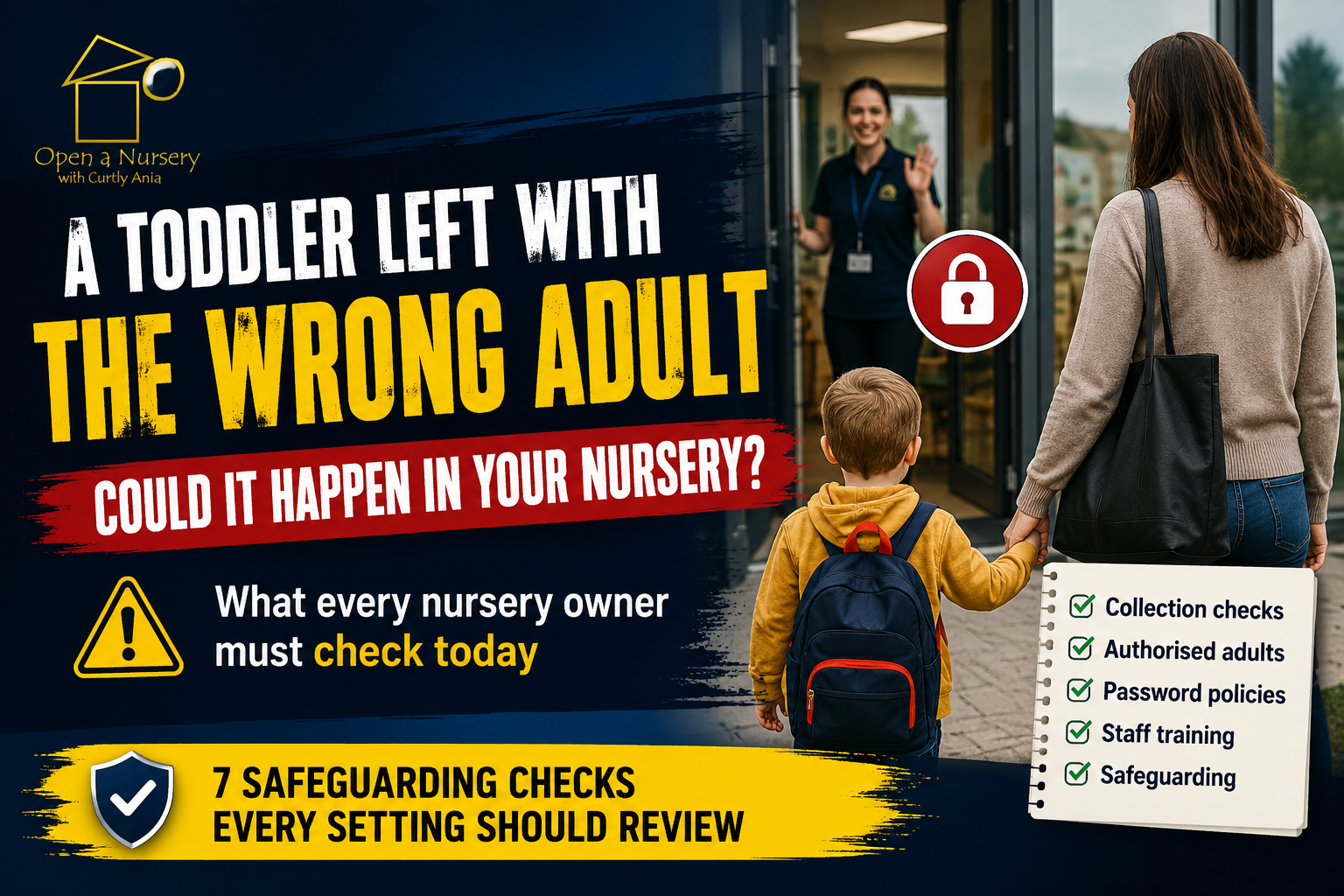
A child was released to the wrong collector
In June 2026, a two-year-old child attending Kids Planet Crosby in Merseyside was mistakenly released to another child’s grandfather.
Importantly, the adult was not an unknown person who had simply walked into the nursery. According to the nursery’s statement reported at the time, he was known to staff, had passed the required security checks and was an approved collector for another child who was also at the setting.
The wrong child was nevertheless released into his care and was driven away from the nursery before being safely returned within minutes.
That distinction matters because it demonstrates something every nursery owner and manager should consider: confirming that an adult is authorised to collect from the nursery is only part of the safeguarding process. Staff must also verify that the correct child is being released to the correct person.
Why this incident deserves attention from every nursery
This was not simply an administrative mistake. It involved the physical release of a young child from the setting to somebody who was not authorised to collect that particular child.
Years old
The child involved was a two-year-old attending the nursery.
Incident reported
The significant safeguarding event took place in June 2026.
Ofsted inspection
Ofsted carried out an unannounced inspection five days later.
Follow-up visit
Ofsted later returned and confirmed the required safeguarding actions had been met.
An important nuance
Describing the collector simply as a “stranger” can obscure one of the most useful lessons from this case. He was reportedly an approved collector for a different child.
That means a nursery’s system needs to verify both sides of the handover: Is this person authorised to collect? And are we releasing the correct child to them?
What did Ofsted find?
Ofsted’s published compliance action states that it carried out an unannounced inspection on 15 June 2026 and found that the provider was not meeting some of the requirements of registration.
Ofsted served a Welfare Requirements Notice, which is a legal notice requiring a provider to take specified action within the stated timescale.
Safeguarding procedures
Staff needed to understand and consistently implement the setting’s safeguarding policies and procedures.
Staff supervision
Supervision arrangements needed strengthening so leaders could evaluate staff practice and identify knowledge gaps effectively.
Risk assessment
Ofsted required robust risk assessment and staffing arrangements so children were appropriately supervised throughout the day.
Transition times
Ofsted specifically referred to avoiding risks during all parts of the day, including key transition times.
The statutory framework is clear about releasing children
The EYFS statutory framework for group and school-based providers requires providers to ensure that children are only released into the care of individuals whom the parent has explicitly notified the provider about.
7 collection safeguards every nursery should check
These are not intended to replace your own safeguarding policy or risk assessment. They are practical questions to help owners and managers test whether the procedure actually works in day-to-day practice.
Verify the collector, not just their familiarity
A member of staff recognising somebody is not the same as confirming that they are authorised to collect the child standing in front of them.
Match the adult to the correct child
This case demonstrates why the collection process needs a deliberate confirmation of which child is being collected.
Where several children have similar names, siblings attend different rooms or staff are covering unfamiliar rooms, the opportunity for human error can increase.
Have a clear procedure for unfamiliar collectors
Staff should know exactly what to do when somebody arrives whom they have never met before, even if that person’s name appears on the authorised collection list.
That could include checking identification, confirming information held by the setting or contacting the parent using contact details already held on file.
Review how collection changes are authorised
Nurseries regularly receive messages such as “Grandad is collecting today” or “my sister will pick her up instead.”
Your procedure should make clear who can authorise the change, how the setting verifies the request and how the information reaches the practitioner who will actually release the child.
Test the system during your busiest collection period
A system that works perfectly when one parent arrives at 3pm may operate very differently when several families arrive together at 5.30pm.
Managers should observe collection during the busiest period and ask whether staff are being distracted, whether doors are being held open, whether practitioners are trying to supervise children while simultaneously answering parents and whether unfamiliar staff are being relied upon.
Make sure bank and cover staff understand the procedure
Collection procedures should not depend on long-serving staff simply “knowing everyone.”
Agency staff, bank staff, apprentices, new starters and practitioners temporarily covering another room need to know exactly what they can and cannot do when releasing children.
Audit practice, not just paperwork
A beautifully written safeguarding policy offers limited protection if practice on the nursery floor is different.
Managers can observe handovers, ask staff scenario questions, sample collection records and test what staff would do if an unexpected collector arrived.
This is particularly relevant because Ofsted’s follow-up action at Kids Planet Crosby included regular observations, audits and “on the spot” questions to check whether staff understood and could consistently implement safeguarding procedures.
Security technology cannot replace safe staff practice
Nurseries increasingly use electronic doors, entry systems, apps, passwords, facial recognition technology and digital collection permissions. These systems can support safeguarding, but none removes the need for professional judgement and a reliable handover procedure.
Controls who gains access to the premises, but does not by itself confirm which child they should leave with.
Confirms who a parent has authorised, but staff must still match the collector to the correct child.
Bring the system together by applying the procedure consistently and stopping the handover when something is unclear.
A five-minute collection safeguarding audit
Ask your manager, deputy or DSL to walk through your collection process from the point an adult reaches the nursery entrance until the child leaves the premises.
Ofsted specifically referred to key transition times
In its compliance action, Ofsted required risk assessment and staffing arrangements to be robust enough to ensure children were appropriately supervised and not exposed to avoidable risks during all parts of the day, including key transition times.
Collection is exactly the type of period where staffing, supervision, parent conversations, door security and children’s movements can all compete for practitioners’ attention.
What should a nursery do after a serious collection incident?
Your response should follow the EYFS, your safeguarding procedures and any advice from the relevant authorities. The immediate priority is always the child’s safety.
Take immediate action to locate or protect the child and prevent any further risk.
Inform the appropriate senior safeguarding lead and follow the setting’s notification and reporting procedures.
Parents need clear, factual information about what has happened and what immediate action is being taken.
Keep accurate contemporaneous records, including who was present and what actions were taken.
Establish whether the issue arose from policy, communication, staffing, training, supervision or failure to implement an existing procedure.
Training alone may not be enough. Leaders should monitor whether revised procedures are actually being followed.
Ofsted later confirmed the required actions had been completed
This part of the case is also useful because it shows the type of action leaders took following regulatory intervention.
Safeguarding audit
The provider completed an internal safeguarding audit to identify gaps in staff knowledge.
Training and coaching
Staff received training and coaching to strengthen understanding of policies designed to keep children safe.
Observations and audits
Leaders strengthened monitoring through regular observations, audits and on-the-spot questions.
Staff supervision
Supervision arrangements were reviewed and staff received recent supervision meetings with leaders.
Staff deployment
Staffing arrangements and deployment records were reviewed to ensure the needs and safety of children were met.
Ofsted follow-up
Following its regulatory visit on 22 July, Ofsted stated that it was satisfied the safeguarding and welfare actions had been met. The provider remained registered.
Questions worth asking your team this week
Instead of asking staff whether they have read the collection policy, test whether they know how to apply it.
Collection should never become an automatic routine
The vast majority of nursery collections happen safely every day. That familiarity can, however, make handover feel routine.
This case is a reminder that one lapse can have extremely serious consequences.
The strongest collection procedures combine secure access, accurate records, clear parent communication, appropriate staffing and practitioners who understand that they have permission to stop a handover whenever anything is unclear.
Most importantly, owners and managers should not limit their compliance checks to whether a policy exists.
Ask whether the policy would still work at 5.30pm on your busiest day, with several parents at the door, staff covering breaks and a collector the practitioner has never met before.
If the answer is uncertain, that is the point to strengthen the system.
Safeguarding needs to work in practice, not just on paper
My CPD certified Safeguarding Level 2 course has been designed specifically for early years and childcare professionals, including nursery practitioners, room leaders, managers, owners and childminders.
It covers practical safeguarding responsibilities, reporting, professional practice, case studies and scenarios that help staff think about how safeguarding applies to everyday nursery situations.
Sources and further reading
This article is intended to provide general information and practical safeguarding considerations for early years providers in England. It does not replace the EYFS statutory framework, your setting’s own safeguarding procedures, professional safeguarding advice or instructions from Ofsted, your local authority or other relevant agencies. Providers should ensure they are following the version of the EYFS framework currently in force.
Free Early Years Updates
Keep up with important early years developments
Subscribe to receive new articles about Ofsted, the EYFS, childcare funding, safeguarding and nursery business directly in your inbox.
- Important Ofsted and inspection updates
- EYFS and childcare policy changes
- Funding and nursery business news
- Clear explanations of what changes mean
Subscribe for free updates
Enter your details below and you will receive an email when a new important article is published.
Your information will be handled in accordance with our Privacy Policy . You can unsubscribe at any time.