
Ofsted Nursery Inspections Changed on 1 September: 7 Things Owners Need to Know
Ofsted’s updated early years inspection toolkit and guidance are now in force. The September 2026 changes strengthen expectations around safeguarding, safer sleeping, eating and weaning, clarify what inspectors will look for and also spell out some paperwork nursery owners do not need to create.
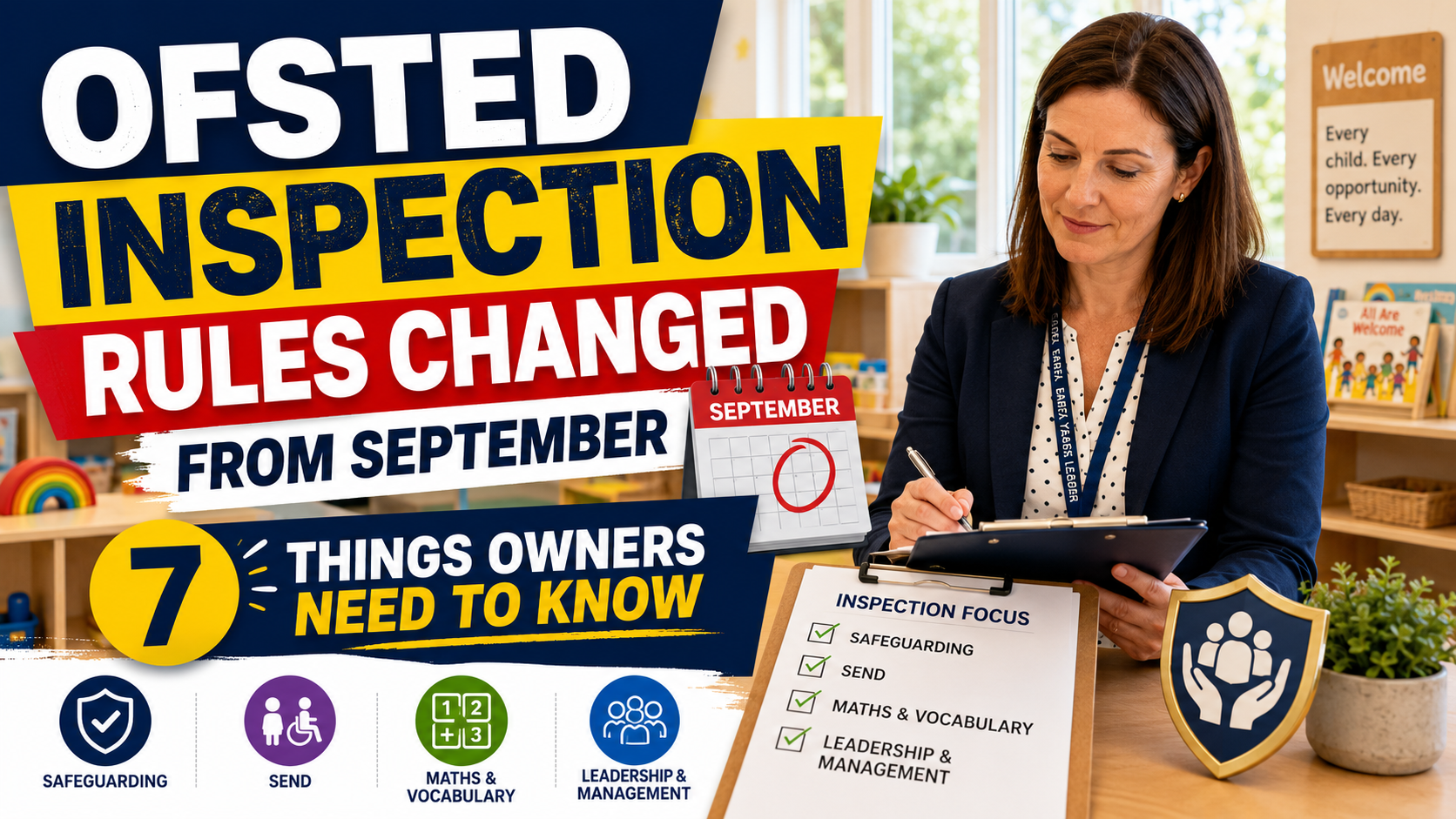
The September inspection update is now live
Ofsted first published the main September 2026 updates to its early years inspection materials in June and made further clarifications on 28 August. The updated toolkit, operating guide and inspection information now apply to inspections taking place from 1 September 2026.
This is not a completely new inspection framework. The renewed education inspection framework has already been in use for early years inspections since November 2025. What has changed is the detail within the early years toolkit and supporting guidance, particularly where the EYFS itself has changed.
For nursery owners and managers, the practical question is therefore not: “How do I prepare a completely new Ofsted folder?”
It is: “Do our everyday practice, leadership decisions and statutory compliance meet the standards Ofsted will now be testing?”
What nursery leaders should know before their next inspection
There are several detailed amendments, but these four points explain the direction of the September changes.
Changes now apply
The updated early years toolkit and operating guide are used for inspections from 1 September 2026.
Care areas under clearer focus
Safer sleeping, weaning and safer eating feature more explicitly in inspection evidence gathering.
Extra inspection folders required
Ofsted says providers do not need written evidence against every toolkit standard or a formal toolkit self-evaluation.
Month reinspection windows
Urgent improvement normally means reinspection within six months. Needs attention normally means within 12 months.
7 things nursery owners need to understand
These are the parts of the September 2026 update most likely to affect how providers prepare, how staff practise and what inspectors explore during a visit.
The updated inspection toolkit is now the version that matters
Ofsted’s September 2026 early years toolkit is now in force. The toolkit is what inspectors and providers use to discuss the quality of provision during inspection.
It works alongside the inspection operating guide and the public inspection information. Providers should make sure that any internal inspection preparation material they are using is based on the current September 2026 documents rather than an older version.
Safer sleeping, eating and weaning have a much clearer inspection focus
Ofsted has added more detail about how inspectors gather evidence around babies’ safer sleeping arrangements, weaning and safer eating.
Inspectors are instructed to check that the relevant statutory guidance is well understood and implemented effectively. These issues feed into children’s welfare and wellbeing and leadership and governance.
Ofsted has also made clear that poor care arrangements can, in some circumstances, affect whether safeguarding itself is graded met or not met.
- Check safer sleep arrangements in practice
- Review supervision while children eat
- Check weaning procedures and information from parents
- Make sure staff understand choking and food safety risks
Meeting the EYFS alone does not automatically secure the expected standard
The updated toolkit clarifies the relationship between statutory compliance and inspection grading.
To be graded at the expected standard, providers need to meet both the relevant EYFS requirements and the grading standards within the inspection toolkit.
That means inspection is not simply a tick-box exercise asking whether a setting has technically complied with individual rules. Inspectors also look at the quality and impact of leaders’ decisions and how effectively practice supports children to achieve, belong and thrive.
DBS evidence for volunteers in regulated activity needs to be accessible
The final August update clarified that inspectors must be able to access information relating to DBS records for volunteers who are engaging in regulated activity.
This is especially important because the rules around regulated activity and supervised volunteers changed from September 2026.
On inspection, reviewing DBS records is one of Ofsted’s initial activities. Inspectors will also discuss recruitment arrangements and paediatric first aid and meet the practitioner who leads on safeguarding.
- Audit regular volunteers
- Check the correct DBS level has been obtained
- Make records easily accessible
- Review safer recruitment procedures
Vocabulary and mathematics have been clarified
The September toolkit clarifies that references to vocabulary mean English vocabulary.
Ofsted has also added an evidence-gathering prompt to clarify the standard relating to the explicit teaching of mathematics.
This does not mean nurseries should turn early years practice into formal classroom lessons. Ofsted also says it does not prefer a particular method of planning, teaching or assessment.
Leaders should, however, be able to explain how their curriculum helps children build knowledge and skills across the seven areas of learning, including how mathematical learning and language development are deliberately supported.
You do not need a giant Ofsted evidence folder
This is one of the most useful clarifications for providers.
Ofsted explicitly says it does not expect leaders to produce written evidence supporting every standard in each evaluation area.
It also says providers are not expected to complete a formal self-evaluation using the toolkit and will not be disadvantaged if they do not have a written self-evaluation.
Ofsted also says providers do not need to prepare a presentation or additional documentation about the setting or its context specifically for inspection.
Lower inspection grades can bring Ofsted back quickly
The renewed grading system does not simply produce an overall “good” or “outstanding” judgement. Evaluation areas are graded separately.
If any evaluation area is graded needs attention, the setting will usually be inspected again within 12 months.
If any evaluation area is graded urgent improvement, the setting will usually be inspected again within six months.
Ofsted may also inspect sooner where it has concerns. Local authorities can use inspection findings when making decisions about funded early education places.
What inspectors may now look at around babies’ care
The updated operating guide tells inspectors to check that statutory guidance for safe sleeping arrangements, weaning and safer eating is understood and implemented effectively. These are not fringe issues. They form part of the evidence about children’s welfare, leadership and, where failings create a risk of harm, safeguarding.
Safer sleep
Inspectors can explore individual sleep routines, staff understanding and whether safer sleeping guidance is reflected in actual practice.
Safer eating
Expect attention to supervision, safe eating arrangements and whether staff understand the needs and risks relating to individual children.
Weaning
Leaders and practitioners should be able to explain how babies’ individual care needs are understood and safely implemented.
Three things Ofsted says you do not need to prepare
Providers often respond to inspection anxiety by generating documents. Ofsted’s own guidance specifically challenges several common misconceptions.
An evidence sheet for every toolkit standard
Leaders are not expected to create written evidence proving every individual standard in every evaluation area.
A formal toolkit self-evaluation document
Ofsted says settings will not be disadvantaged because they do not have a written self-evaluation using the toolkit.
A special Ofsted presentation
Providers are not expected to prepare a presentation or additional documentation about their setting or context solely for inspection.
What inspectors are instructed to prioritise on site
The operating guide is useful because it shows providers where inspection activity is likely to begin.
Inspection is designed around first-hand evidence
Ofsted says inspectors should prioritise what they see, hear and discuss during the inspection rather than asking providers to manufacture additional evidence.
That means staff confidence, children’s experiences, leaders’ knowledge and everyday routines matter enormously.
A practical September inspection-readiness audit
Use the toolkit to generate conversations and test your practice rather than turning every standard into another form.
The mindset I would recommend to nursery owners
“What paperwork can we make to prove we’re ready?”
This can result in managers spending hours producing evidence packs that practitioners never use and that Ofsted does not require.
“If Ofsted walked in today, what would they actually see?”
Look at children’s daily experiences, safeguarding culture, staff knowledge, leadership oversight, curriculum implementation and whether known weaknesses are being improved.
How quickly could Ofsted return?
The grade in an individual evaluation area can affect the timing of the next inspection.
Where all seven evaluation areas are expected standard, strong standard or exceptional, the provider will usually be inspected again within four years.
If any evaluation area is graded needs attention, Ofsted says the provider will usually be inspected again within 12 months.
If any evaluation area is graded urgent improvement, the provider will usually be inspected again within six months.
Don’t prepare for Ofsted by trying to perform for Ofsted
The September 2026 updates are important, particularly around safeguarding, safer sleeping, weaning, eating and DBS records. But the best response is not to create another hundred pages of inspection paperwork.
The strongest preparation is to understand the current EYFS, read the current inspection toolkit, know your setting’s strengths and weaknesses and make sure what happens in practice genuinely matches what your policies and leaders say should happen.
If your staff understand the children, safeguarding is embedded, care routines are safe, leaders know what needs improving and practitioners can explain the thinking behind their practice, you are preparing for more than an inspection. You are strengthening the nursery itself.
Want support preparing your nursery for Ofsted?
I provide practical support for nursery owners and managers, including Ofsted preparation, consultations and early years training through Open a Nursery UK.
Official sources and further reading
This article provides general information for early years providers in England and is based on Ofsted guidance available on 2 September 2026. It does not replace the EYFS statutory framework, Ofsted’s current inspection documents or professional advice relating to an individual setting. Providers should always check the latest official guidance.
Free Early Years Updates
Keep up with important early years developments
Subscribe to receive new articles about Ofsted, the EYFS, childcare funding, safeguarding and nursery business directly in your inbox.
- Important Ofsted and inspection updates
- EYFS and childcare policy changes
- Funding and nursery business news
- Clear explanations of what changes mean
Subscribe for free updates
Enter your details below and you will receive an email when a new important article is published.
Your information will be handled in accordance with our Privacy Policy . You can unsubscribe at any time.