
Childcare Sector Update
CMA Childcare Market Review 2026: What It Could Mean for Nursery Owners
The Competition and Markets Authority has launched a major investigation into how England’s early years and childcare market is working for families, providers and the wider economy.
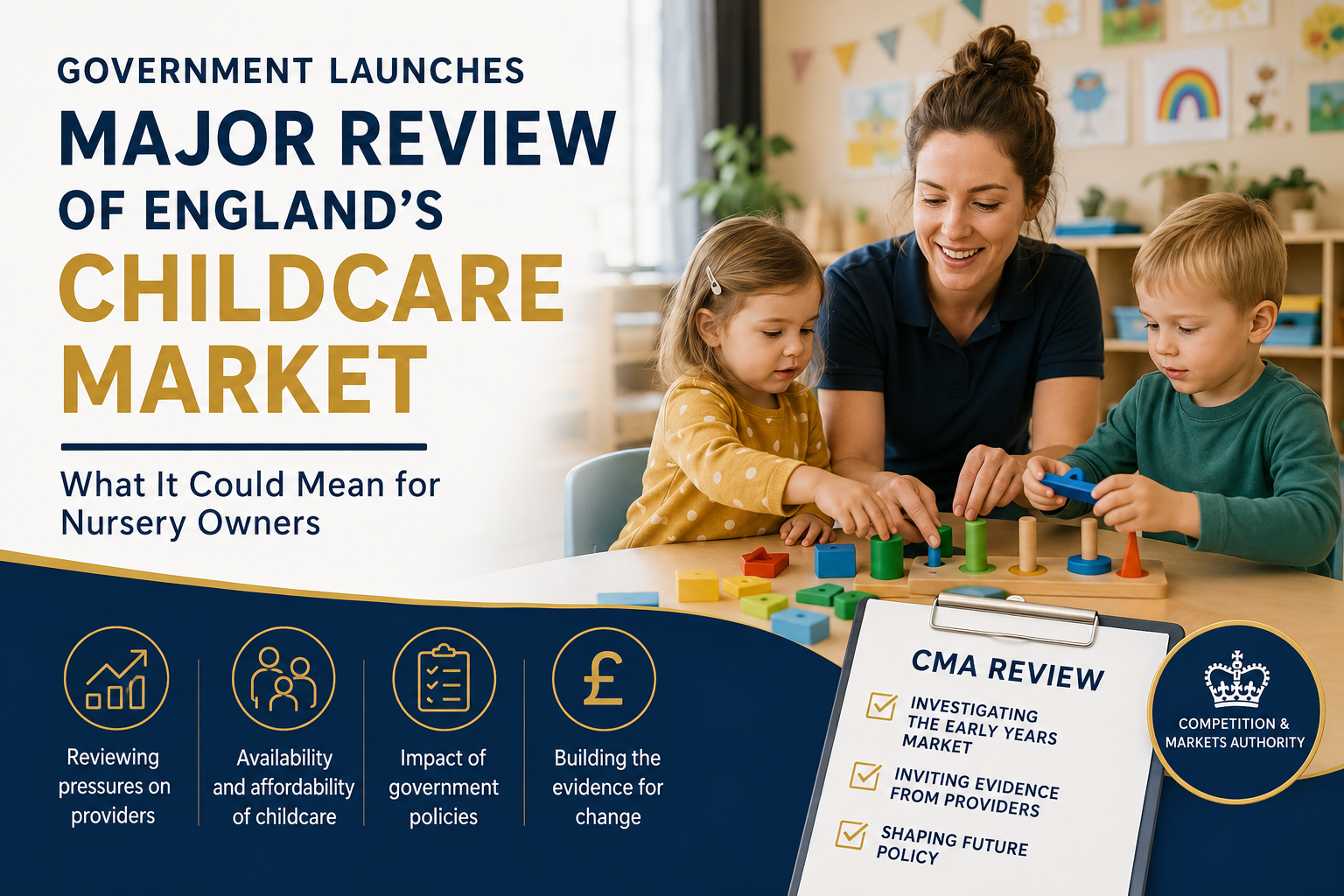
The CMA is examining how early years education and childcare services are operating across England.
This is not simply another consultation about childcare. The CMA has statutory powers to investigate markets and make recommendations where it believes change could produce better outcomes. Its findings could influence future decisions about childcare funding, regulation, provider sustainability, family choice and the structure of the early years market.
Estimated childcare providers delivering early years services to children aged 0 to 4 in England.
Estimated childcare and early years places across England.
Approximate annual value of England’s childcare and early years sector.
Approximate government investment in funded early years entitlements during 2025 to 2026.
What is the CMA childcare market study?
The Competition and Markets Authority, usually referred to as the CMA, is examining the supply of early years education and childcare services in England.
The study covers provision for children from birth until they start school at around four or five years old. This includes nurseries, pre-schools, childminders and school-based early years settings.
The purpose is to establish how well the market is working for families and providers, identify areas that may not be functioning effectively and consider where practical improvements could be made.
It sits alongside the Government’s wider review of childcare provision. The Education Secretary asked the CMA to provide an independent assessment that could help inform that work.
What will the CMA investigate?
The proposed scope is much wider than simply looking at the prices parents pay. It includes the financial and structural pressures affecting childcare businesses.
Availability and access
Whether enough places are available, where childcare shortages exist and whether provision meets needs such as SEND, non-standard hours and different age groups.
Affordability and funding
How provider costs, funded entitlement rates and the funding model affect fees, affordability and nursery sustainability.
Information and family choice
Whether families receive clear information about fees, funding, availability, contract terms and the childcare choices open to them.
The role of public bodies
How local authorities, combined authorities, government departments and regulatory systems influence the way childcare is delivered.
Provider costs
The underlying costs of delivering childcare, including staffing, property, administration, regulation and delivering funded places.
Ownership and provider models
How independent nurseries, charities, schools, nursery groups, private equity-backed providers and childminders affect costs, capacity and family choice.
Why should nursery owners pay attention?
Many of the questions included in the market study relate directly to the concerns nursery owners have raised for years.
Does funded childcare cover the true cost of delivery?
The CMA intends to examine whether government-funded hours cover providers’ costs and how settings manage any gap. This may include the use of private fees, additional hours, consumable charges and other forms of cross-subsidy.
What is preventing nurseries from opening or expanding?
Property availability, planning, registration times, staffing, local authority processes and the cost of expansion can all act as barriers. The CMA will consider barriers to entry and growth within the market.
Are different types of providers competing on equal terms?
Independent nurseries, school-based provision, charities, large nursery groups and childminders operate under different business models. The study could examine how funding and public policy affect those providers differently.
Can parents clearly compare childcare options?
The study will consider whether families receive sufficient information about fees, additional charges, funding and contractual arrangements before selecting a provider.
What the CMA study will not cover
- It will not assess the educational standards of individual nurseries or childminders.
- It will not replace an Ofsted inspection or regulatory investigation.
- Its formal scope is England because childcare funding and regulation are devolved.
- Nannies and informal childcare that cannot deliver funded hours are outside the main study.
- The launch of the study does not mean that the CMA has already decided what changes should be made.
Its eventual findings will depend on the evidence gathered from families, providers, government bodies, local authorities and other organisations.
The expected timeline
-
July 2026
Market study launched
The CMA publishes its proposed scope and invites initial responses from providers, professionals, families and other interested parties.
-
26 July 2026
Initial call for views closes
The deadline for providers and professionals to submit their initial experiences and views.
-
July–December 2026
Evidence gathering and analysis
The CMA will engage with providers, families, experts, public bodies and regulators while analysing market information.
-
Dec 2026–April 2027
Emerging findings and possible improvements
Consultation is expected on the CMA’s emerging thinking and any possible options for improving outcomes.
-
May 2027
Final report expected
The CMA currently expects to publish its final findings and recommendations in May 2027.
What evidence should nursery providers share?
This is an opportunity for providers to give the CMA practical evidence rather than relying only on general statements that the sector is under pressure.
Funding and delivery costs
Evidence comparing funded rates with staffing, property, food, consumables, administration and other real delivery costs.
Staffing challenges
Recruitment difficulties, qualification requirements, wage pressure, agency costs and the effect of ratios on financial sustainability.
Local authority processes
Experiences of funding administration, payment timings, sufficiency planning, support and local variations.
Expansion barriers
Planning, property, registration, finance, staffing and regulatory obstacles preventing settings from opening additional places.
Parent fees and additional charges
How funded places affect private fees, consumable charges, optional services and the ability to explain costs clearly to families.
SEND and specialist provision
The additional costs and practical challenges of meeting needs where funding or specialist support is delayed or insufficient.
Nursery providers have an opportunity to be heard
The provider call for views closes on 26 July 2026. Clear, practical examples supported by figures or real experiences may help the CMA understand how the childcare market is operating on the ground.
What could happen after the review?
No outcome has been decided. However, depending on the evidence, possible outcomes could include:
- recommendations to government about childcare funding design or distribution;
- recommendations relating to regulation or the role of public bodies;
- improvements to information available to families and childcare providers;
- guidance for childcare businesses or consumers;
- further consideration of particular consumer protection concerns;
- evidence that helps shape future childcare policy.
The study is unlikely to produce an immediate change to nursery funding or regulation. Its importance is that it could create an independent evidence base for decisions taken during 2027 and beyond.
Official sources
This article is based on information published by the Competition and Markets Authority on 1 July 2026.
This article provides general information and commentary for early years professionals. The market study remains open and its scope, timetable and conclusions may be updated by the CMA. Always consult the current official pages before submitting a response.
Free Early Years Updates
Keep up with important early years developments
Subscribe to receive new articles about Ofsted, the EYFS, childcare funding, safeguarding and nursery business directly in your inbox.
- Important Ofsted and inspection updates
- EYFS and childcare policy changes
- Funding and nursery business news
- Clear explanations of what changes mean
Subscribe for free updates
Enter your details below and you will receive an email when a new important article is published.
Your information will be handled in accordance with our Privacy Policy . You can unsubscribe at any time.