

Doubled Capacity
6 under-8s per additional adultMax 2 Hours / Day
Requires PFA & parent consentEnhanced DBS Check
Must register with OfstedPAYE & Insurance
Employer’s liability requiredAs your home childminding business grows, reaching your maximum capacity of children can happen quickly. Hiring a childminder assistant is one of the most effective ways to scale your income, increase your ratios and share daily workload responsibilities without moving into commercial premises.
However, employing an assistant transitions you from a sole trader into an employer. This comes with specific statutory framework rules, employment laws and wage requirements that you must manage correctly from day one.
1. How Ratios Scale When You Hire an Assistant
Under the Early Years Foundation Stage (EYFS) framework, a solo childminder can care for up to 6 children under the age of 8, of which no more than 3 can be young children (under 5), and a maximum of 1 baby under the age of 1.
When you bring a qualified assistant into your setting, your child ratio scales on an additional adult-to-child ratio basis:
Solo Childminder
6 Children
- Max 3 under age 5
- Max 1 baby under age 1
- Includes your own young children
Childminder + 1 Assistant
12 Children
- Max 6 under age 5
- Max 2 babies under age 1
- Space requirements per child must still be met
Increasing staff numbers increases your allowed capacity, but your home floor space must still accommodate each child. Check our detailed guide on childminder ratios and floor space rules before expanding.
2. The Sole Charge Rule: Leaving Assistants Alone with Children
Can an assistant look after children on their own while you run errands or manage school runs? Yes, but strict legal conditions apply under the EYFS framework.
Statutory Requirements for Sole Charge (Up to 2 Hours)
You may leave an assistant in sole charge of mindees for a maximum of 2 hours in any single day, provided all of the following criteria are met:
3. Employer Obligations: Wages, PAYE & Insurance
When you employ someone in the UK, you take on legal responsibilities under employment law and HMRC regulations.
Essential Legal & Financial Steps
- National Minimum Wage / Living Wage Compliance: You must pay your assistant at or above statutory national wage rates based on their age bracket or apprenticeship status.
- Employer’s Liability Insurance: Legally required as soon as you hire staff (minimum £5 million cover). Standard public liability policies do not automatically cover employees. Learn more about policy add-ons in our guide to childminder insurance requirements.
- HMRC Registration & PAYE: Register as an employer with HMRC before your assistant’s first payday to deduct Tax and National Insurance correctly.
- Written Employment Statement: Under UK employment law, you must provide a written employment contract outlining working hours, pay rate, holiday entitlement and notice periods on or before their first working day.
Factoring these ongoing staff payroll and insurance costs into your financial planning is crucial. Review our complete analysis of childminder start-up costs and budgeting to safeguard your profitability.
The Childminding Journey Made Simple: Your All-in-One EYFS Solution
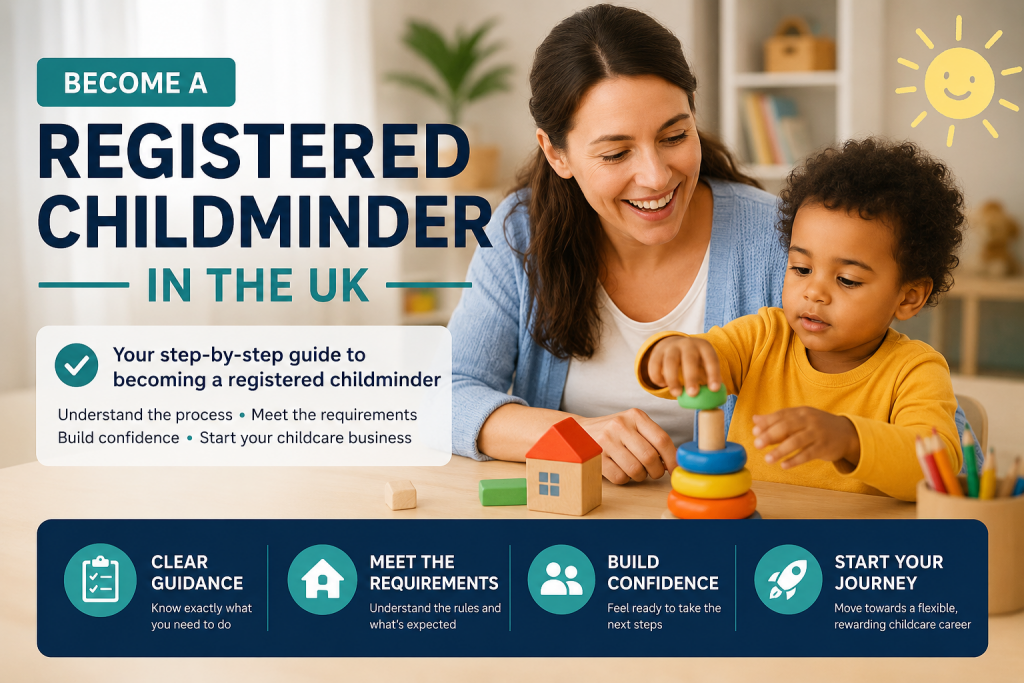
If setting up your childminding business feels overwhelming, that is completely normal. Every practitioner feels this way at the beginning.
That is exactly why we created the Become a Registered Childminder in the UK: Step-by-Step Course.
Inside the course, you will get:
- Clear EYFS explanations: Easy, jargon-free guidance so you know what Ofsted requires.
- Real examples: Learn how successfully registered childminders set up their homes and passed inspection.
- Ready-made templates: Fully editable policies, contracts, risk assessments and planning sheets.
- Video walkthroughs: Step-by-step tutorials so you never feel lost or confused.
- Affordable investment: Everything for just £49 with lifetime access and no agency fees.
4. Step-by-Step Assistant Hiring Workflow
Job Description & Candidate Interview
Draft clear job responsibilities, interview candidates, take up professional references and verify right-to-work documentation.
Enhanced DBS & Ofsted Declaration
Apply for an Enhanced DBS check via the Ofsted portal. Submit an EY2 form to declare a new assistant working in your setting.
Insurance & HMRC Registration
Add Employer’s Liability to your business insurance policy and establish a PAYE payroll scheme with HMRC.
Induction, Safeguarding & First Aid Training
Deliver a structured induction covering setting policies, child protection procedures, health & safety rules, and enroll them in Paediatric First Aid training.
5. Scaling Beyond Home Limits: Childcare on Domestic Premises (CoDP)
As your demand increases, you may decide to hire additional assistants or co-minders to build a larger team.
If your team grows so that 5 or more individuals (including childminders and assistants) are working together on residential premises at any one time, your business legal status changes. You must register under Childcare on Domestic Premises (CoDP).
A CoDP setting provides nursery-level service capacity while operating within a home environment. Transitioning to CoDP requires formal staff management, strict policy structures and team induction processes. Using standardized approved nursery policies and procedures ensures your expanding team stays compliant. For step-by-step guidance on scaling your home setting, explore our practical Open a Nursery from Home (CoDP) course.
Not Ready to Enrol Yet? Get Your Free Childminder Startup Guide
We understand that becoming a childminder is a big decision, and you might need a little more clarity before investing.
Download our FREE Childminder Startup Checklist to get a head start on planning your business and preparing your home.
Inside, you will get:
- The 3 essential steps you can take today without spending a penny.
- A clear breakdown of initial costs to expect.
- A summary of required space, equipment and safety measures.