
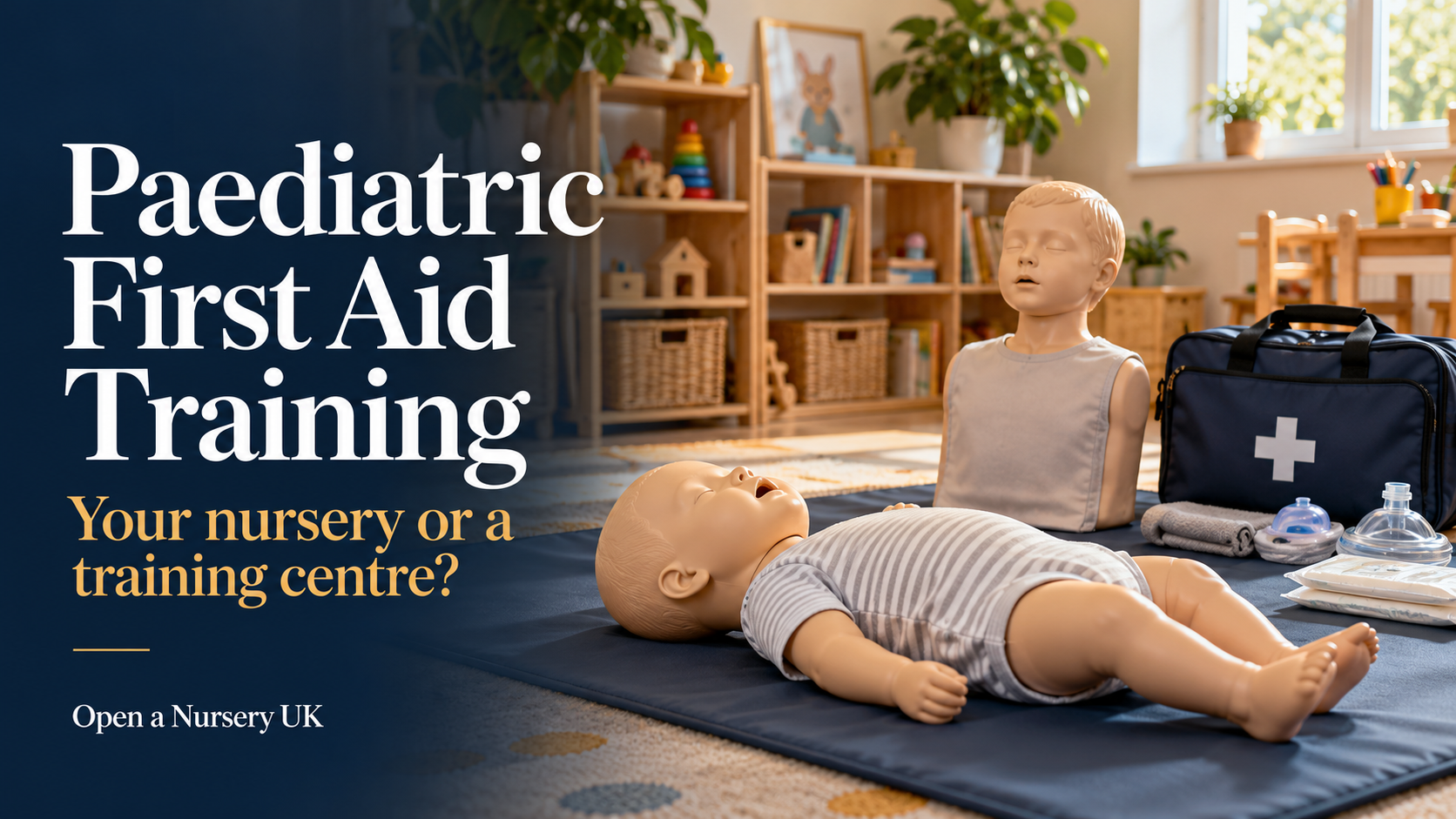
Paediatric First Aid Training: At Your Nursery or at a Training Centre?
 By Curtly Ania6 minute readInformation checked: 14 October 2026
Should you bring a paediatric first aid trainer to your nursery or book staff onto a local course? Compare the required course, attendance, staffing cover and complete cost before choosing the location.
Jump to a section
- Choose the course before choosing the venue
- At your nursery or at a centre: the practical comparison
- When training at your nursery makes sense
- When a centre course may work better
- Compare the complete cost
- Questions to ask the training provider
- Plan ongoing cover, not just one training day
- Curtly’s advice: choose the workable arrangement
- Common questions
- Sources and further reading
Choose the course before choosing the venue
Start with what staff need to achieve. A full paediatric first aid course, an emergency course and a refresher are different purchases. A cheaper price for a shorter course is not a like-for-like saving if it does not meet the need you are trying to cover.
For England, the current EYFS Annex A sets out criteria for paediatric first aid training. Full PFA training should last at least 12 hours excluding breaks; emergency PFA should last at least six hours and be face-to-face. The emergency elements of a full course should also be delivered face-to-face. Here, face-to-face means the trainer is physically present, not a video call. Certificates must be renewed every three years.
Ask the provider to identify the exact course, practical attendance, assessment and certificate before comparing dates or venues. Where blended learning is offered, confirm what is online, what is in person and the completion deadlines.
At your nursery or at a centre: the practical comparison
| Consideration | At your nursery | At a training centre |
|---|---|---|
| Booking model | Often a group booking; confirm minimums | Often individual places; check availability |
| Travel | Trainer travels to you if coverage is confirmed | Staff travel to the stated venue |
| Room and facilities | Your setting provides a suitable space | Provider arranges the venue; confirm access |
| Staff attendance | Potentially convenient for a group | Can spread attendance across different dates |
| Contingency | A cancellation may affect the whole group | Alternative dates may help, subject to terms |
On smaller screens, swipe across the table to see every column.
The best option depends on team size, renewal dates, nursery cover and suitable dates. Neither location is inherently evidence of better training.
When training at your nursery makes sense
An on-site course can be practical when several staff need the same training around the same time. It may reduce travel and make a shared date easier to arrange. Compare the group quote with the number of people who will actually attend, not the maximum course capacity.
Ask the trainer what the room needs: floor space for practical work, equipment setup, furniture, accessibility, facilities and time before and after the session. Training while the nursery is open requires a realistic staffing plan. Staff completing practical assessment cannot also be treated as if they are fully available to supervise children.
Confirm whether the provider really travels to your postcode, any travel charge and the permitted group size. A company’s office address is not evidence that it offers training at your nursery.
When a centre course may work better
A centre course can suit one or two new starters or staff whose certificates expire at different times. Booking separate dates can preserve nursery cover rather than sending everyone together. It can also avoid the need to clear a suitable training room.
Check the actual course venue, not just the provider’s registered address. Confirm parking, public transport, accessibility, start and finish times, breaks and any food arrangements. A nearby pin is useful only if there is a real course staff can book there.
Ask when the course date becomes definite and what happens if enrolment is too low. Include travel time and cover costs in the decision. An inexpensive place further away may not be the least expensive option for your nursery.
Compare the complete cost
Ask for a written total covering tuition, assessment, certification, learning materials, online access if relevant, venue or trainer travel fees and tax treatment. Then add the costs your setting carries: staff time, replacement cover and travel.
For group training, divide the total by realistic attendance. Check what happens if one person cannot attend, fails to complete the online component or needs further assessment. For centre courses, ask about substitution, transfers and cancellation charges.
Keep renewal planning separate from a short refresher. Refresher activity can support skills, but ask whether the course you are buying actually renews the required certificate. Do not infer that from the word “update”.
Questions to ask the training provider
- Which course are you quoting for, and how does it address current EYFS Annex A criteria?
- How much training is physically in person, and where?
- How are practical skills assessed?
- What baby and child practice equipment is available?
- What are the trainer’s relevant qualifications and experience?
- What certificate is issued, and when?
- What adjustments can you make for staff access needs?
- What happens after an unsuccessful assessment or a cancelled course?
- What is included in the price?
“EYFS compliant” is a claim to check against the course details, not a substitute for those details. Do not describe a company as Ofsted approved simply because its training is marketed to nurseries.
Plan ongoing cover, not just one training day
In England, the EYFS requires at least one person with a current full PFA certificate on the premises and available when children are present, and on outings. Plan against the current framework’s wider requirements and your setting’s needs, including absences and shifts.
Create a training record with staff member, course, provider, completion date, expiry date and booked renewal. Review it when people join, leave or change working patterns. Having one certificate on file does not automatically make your cover resilient.
Keep evidence of qualifications accessible and ensure the team knows the nursery’s own emergency procedures. A training course is one part of readiness; it does not replace your staffing and emergency planning.
Curtly’s advice: choose the workable arrangement
I would compare the course first, then the training arrangement and full cost. For a whole team, bringing the trainer to you may be convenient. For a single starter, an available local centre place may be more practical.
Use the directory’s postcode and delivery filters to find possibilities, then confirm the date and address directly. Published training venues and areas where trainers travel are different things. Book around the nursery’s staffing plan rather than choosing a date first and trying to solve cover afterwards.
Common questions
Can all paediatric first aid training be online?
Not where the course needs to meet the England EYFS face-to-face criteria described above. Ask for the exact practical arrangement and assessment before booking.
Does a listed office mean the provider holds courses there?
No. Confirm an actual training venue and date. A provider may travel to nurseries without running open courses at its office.
Is emergency PFA the same as full PFA?
No. They differ in duration and content. Choose against the staff role and current requirements rather than comparing their prices as interchangeable courses.
Sources and further reading
Sources checked 14 October 2026. Current EYFS, including Annex A · Government first-aid guidance. Guidance referring to the EYFS applies to England; check the relevant framework for your nation. Supplier details and terms should be confirmed before ordering.
Find suppliers that suit your nursery.
Use the comparison directory to narrow your options, then confirm the details that matter to your nursery directly with the supplier.