
When Does a Childminder Need Planning Permission?
The Definitive UK Guide
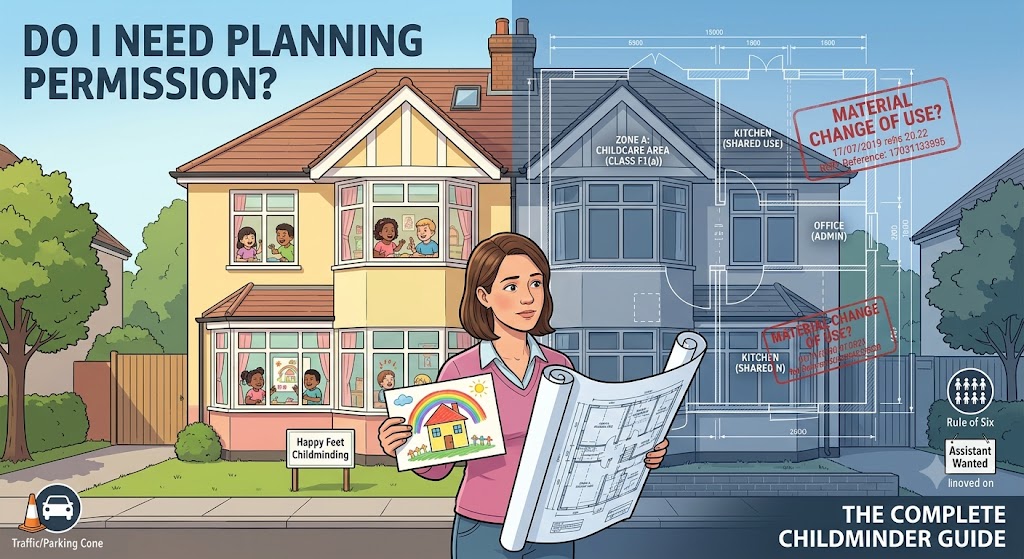
If you look through early years forums, you will find endless debates on Ofsted ratios, tax deductions, and safeguarding rules. But there is one quiet, administrative hurdle that catches hundreds of expanding childcare businesses off guard every single year: Planning Permission.
With the massive rollout of expanded government childcare funding, demand for home-based places has skyrocketed. To meet this demand, many childminders are looking to expand, whether by taking on an assistant, partnering with a co-childminder, or converting a garage.
However, the moment your home business shifts from a solo operation into a larger setting, you enter a legal grey area managed by your local council’s planning department. Operating without the correct planning consent is not just a breach of local authority rules; it can lead to Ofsted suspending your registration during an enforcement investigation.
This comprehensive guide breaks down the high-volume, low-competition topic of Childminder Planning Permission, explaining exactly when you can operate under “incidental use” and when you must submit a formal application.
1. The Core Legal Test: “Material Change of Use”
Under UK planning law, you do not automatically need planning permission to run a business from home. The foundational test applied by the Planning Inspectorate is whether your business causes a “material change of use” to the property.
In simple terms: Is your home still primarily a private residence, or has it effectively become a commercial nursery that happens to have a bed in it?
For a standard, solo childminder, the government’s historical guidance (originally under PPG4) established that childminding within standard recommended ratios does not alter the residential character of a property. If you are just starting out and establishing your home setup, you can learn how to lay these proper compliance foundations in our step-by-step childminder registration course.
2. The Magic Number: The “Rule of Six”
While there is no single statutory number written into national planning law, decades of planning appeals and local authority precedents have established a general rule of thumb regarding child numbers:
Up to 6 Children: If you are caring for a maximum of six children at any one time (including your own dependent children), it is highly unlikely to be deemed a material change of use. The noise, traffic, and comings-and-goings match what you might expect from a large, busy family home.
More than 6 Children: The moment you consistently care for seven or more children on the premises, the risk of a neighbour complaining about noise or parking increases. Most local planning authorities (LPAs) view this intensification as a material change of use that requires formal permission.
3. Trigger Points: When You Will Need Planning Permission
Even if you think your property can handle the numbers, certain specific operational changes act as red flags for local council enforcement officers. You will almost certainly need to engage with the planning department if any of the following apply:
Working with Assistants or Co-Childminders
The moment you hire a paid assistant or work alongside a partner, the dynamic changes. You now have non-residents arriving daily to work, parking their cars, and managing additional cohorts of children. Even if you are remaining strictly within your legal childminder ratios and compliance limits, the planning department evaluates the amenity impact on your street, not just the Ofsted rules.
Notable Increases in Traffic and Parking
If you have ten parents dropping off toddlers between 7:30 am and 8:30 am, your quiet residential cul-de-sac suddenly experiences a commercial traffic pattern. If cars block neighbours’ driveways or cause congestion, a complaint to the council will trigger a planning enforcement visit.
Major Structural Alterations
Building a minor garden room to use as an extension of your family living space often falls under Permitted Development. However, if you are converting an outbuilding or garage solely and exclusively for commercial childcare, with separate access routes or dedicated child toilets, the council will argue that the property’s primary use has split into a commercial zone.
4. The Risk of Getting It Wrong
Some providers choose to adopt a “don’t ask, don’t tell” policy regarding their local council. This is a high-risk business strategy.
If a neighbour complains about noise or traffic, the council’s planning enforcement team will investigate. If they determine you are operating a business without the required change of use permission, they can issue a Planning Enforcement Notice.
When Ofsted becomes aware that a provider is operating in breach of local planning laws, they are highly likely to pause or suspend the registration until the matter is resolved. If your setting is closed for six weeks while you fight a planning battle, the financial hit to your cash flow and reputation can be fatal. This is why anticipating these hidden legal fees is a critical element when evaluating your long-term childminder start-up costs and profitability.
5. How to Protect Your Business: Two Legal Routes
If you want to scale up your business safely, you have two clear avenues to ensure your premises are fully lawful.
Route A: Lawful Development Certificate (LDC)
If you are caring for between 3 and 6 children, or perhaps working with one assistant but cause zero disruption to your street, you can apply for a Certificate of Lawfulness for a Proposed Use or Development.
What it is: This isn’t planning permission; it is a legally binding document from the council confirming that your current childminding setup does not constitute a material change of use.
Why you want it: It acts as an absolute shield against future neighbour complaints and adds significant value if you ever sell your house.
Route B: Change of Use Application (Class E to F1)
If you are transitioning your business into a larger, multi-staff model, you will need to apply for a formal Change of Use. Under the current planning use classes, childcare generally sits within Class E(f) or F1(a) depending on the exact setup.
The Process: The council will review your floor plans, check your parking arrangements, and consult your immediate neighbours.
The Cost: Application fees vary by local authority but usually sit between £500 and £1,500, excluding the cost of professional architectural drawings.
6. Scaling Beyond the Solo Model: The CoDP Factor
For the highly ambitious childminder, the natural progression of filling your spaces is moving toward the Childcare on Domestic Premises (CoDP) framework.
As we have highlighted in previous guides, the exact transition point is the “Rule of Five.” The moment you have five or more adults (including yourself, co-minders, and assistants) working simultaneously on a domestic property, you are legally no longer a childminder. You are a group provider running a domestic nursery.
From a planning perspective, a CoDP setting always requires planning permission. You are managing a multi-staff payroll, navigating commercial-scale utility demands, and likely operating a kitchen that serves dozens of meals a day. To safely manage this massive transition without risking your registration, our Open a Nursery from Home (CoDP) course provides the exact planning templates, statement templates, and architectural advice required to secure council approval.
7. Crucial Pre-Checks: Deeds and Tenancies
Before you even look at council planning websites, check the private legal restrictions on your property:
Restrictive Covenants: Many modern housing developments contain covenants in the deeds that explicitly forbid the running of any business from the property.
Landlord Permission: If you rent your property, operating a commercial business without written landlord consent is a breach of your tenancy agreement and a quick route to eviction.
Mortgage Providers: Standard residential mortgages often require you to notify the lender if a significant portion of the property is being utilised for commercial gain.
8. Summary Checklist for Childminders
To keep your business protected and compliant, execute these steps in order:
[ ] Audit your numbers: Are you planning to exceed 6 children under 8 at any one point in the day?
[ ] Review your staff plans: Will you be deploying an assistant who parks on your residential street?
[ ] Check property deeds: Ensure no restrictive covenants ban home-based businesses.
[ ] Apply for an LDC: If you are operating on the edge of 6 children, secure a Lawful Development Certificate for peace of mind.
[ ] Professionalise your paperwork: If you need to submit a planning application, use our pre-written nursery policies and procedures to demonstrate to the council that your setting operates with the highest level of corporate structure and safety compliance.
Conclusion
Securing planning permission or an LDC might feel like an unwelcome administrative hurdle when you simply want to focus on early years education. However, viewing your premises through the lens of local planning laws is what separates an amateur hobbyist from a resilient business owner.
Take the time to assess your setting’s impact on your neighbourhood today. By proactively managing your relationship with the local planning authority, you secure the legal foundations of your home nursery, ensuring your business can scale safely, profitably, and without fear of disruption.
The Childminding Journey Made Simple: Your All-in-One EYFS Solution

If the EYFS still feels overwhelming, that’s normal.
Every childminder feels this way at the beginning.
That’s exactly why I created the Become a Registered Childminder in the UK – Step-by-Step Course.
Inside the course, you’ll get:
✔ Clear EYFS explanations (no jargon)
Understand what Ofsted wants and how to meet the requirements easily.
✔ Real examples from childminders I’ve trained
Learn how they passed inspection and set up their homes.
✔ Ready-made templates
Policies, contracts, risk assessments, planning sheets.
✔ Video walkthroughs of each step
So you never feel lost or overwhelmed.
✔ Everything for just £49
And you keep all your profits — no agency fees.
Why This Course is Your Essential Tool:
Saves Months of Guesswork: Get clear, beginner-friendly guidance with no jargon, so you know exactly what to do and in what order.
Avoids Costly Mistakes: Set up correctly from the very start, avoiding common pitfalls that delay registration or cost you money.
Everything You Need: The course provides clear video lessons, written guides, essential checklists, and editable templates for your policies and contracts.
Proven Support: Built by professionals who’ve opened nurseries and successfully registered multiple childminders, giving you real inspection examples.
Affordable Investment: For a single, one-time payment of £49.00, you get lifetime access and save hundreds in potential agency fees by learning to register directly.
By the end of this course, you will not only know exactly how to register with confidence but also be ready to run your business professionally and profitably.
Ready to take the confusion out of registration?
Not Ready to Enrol Yet? Get Your Free Childminder Startup Guide
We understand that becoming a childminder is a big decision, and you might need a little more clarity before investing.
Download our FREE Childminder Startup Checklist to get a head start on planning your business and preparing your home.
Inside, you’ll get:
-
The 3 Essential Steps you can take today without spending a penny.
-
A breakdown of the initial costs to expect.
-
A summary of the required space and equipment.
This is the perfect next step for anyone in the planning stage.