
New EYFS 2026: Key Changes Nurseries and Childminders Need to Know
The new Early Years Foundation Stage frameworks apply from 1 September 2026. Here are the main changes around safer sleep, safer eating, screen use, safeguarding and banned dog breeds.
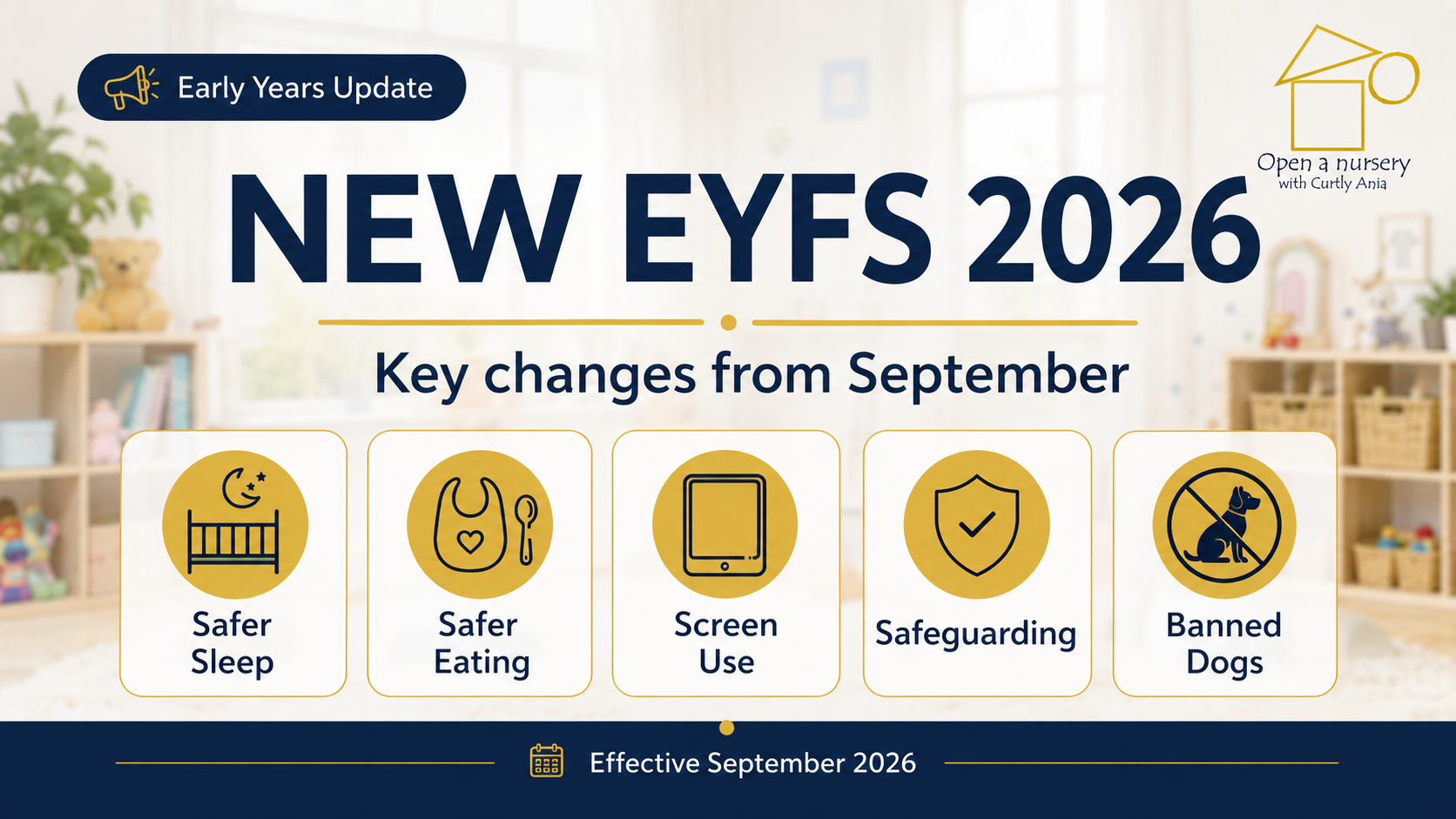
The Department for Education has released new EYFS statutory frameworks that come into force from 1 September 2026. The changes are not a full curriculum overhaul, but they do make important updates to safeguarding and welfare requirements.
The new frameworks apply to both childminders and group and school-based providers. The main changes include clearer safer sleep requirements, new expectations around screen use, a ban on childcare where banned dog breeds are present, and several safeguarding clarifications.
For nursery owners, managers, childminders and early years practitioners, this is an important update to understand before September. Some of the changes may require settings to update policies, review staff training and check that daily practice matches the new wording.
Quick summary of the EYFS 2026 changes
- New EYFS frameworks apply from 1 September 2026.
- Safer sleep requirements are now much clearer in the main EYFS wording.
- Providers must have regard to new DfE guidance on screen use.
- Childcare must not take place where banned dog breeds are present or kept.
- Safeguarding policy and training expectations have been clarified.
- Safer eating, weaning, allergy and choking expectations are more detailed.
- There are notification clarifications for childminders and domestic premises.
Important: This article summarises the main changes, but providers should still read the full EYFS framework that applies to them. There are separate versions for childminders and group or school-based providers.
1. Safer sleep requirements are now clearer
One of the biggest changes is the clearer wording around safer sleep. The new EYFS sets out more explicit requirements for children under 2.
Providers must ensure children are placed down to sleep safely. For children under 2, this includes being placed on their back, in their own separate sleep space, on a firm flat surface. Babies aged 12 months and under must only be placed to sleep in a cot.
Sleep spaces should only contain a firm, flat, waterproof mattress and suitable lightweight bedding. Cots must not contain extra items such as toys, pillows, cot bumpers, extra blankets, wedges or straps.
The new wording also says babies under 6 months must always have an adult with them in the same room for every sleep. Sleeping children must be within sight and hearing of staff and checked frequently.
What providers should check
- Review your safer sleep policy.
- Check baby room sleep arrangements.
- Remove unnecessary items from sleep spaces.
- Make sure staff understand how sleep checks are completed.
- Check room temperature, bedding and cot use.
- Make sure parents understand your safer sleep approach.
2. Safer eating and weaning expectations are more detailed
The new EYFS also strengthens expectations around safer eating, choking risk and weaning.
Providers must have ongoing conversations with parents about the stage their child is at with solid foods, including textures. The framework makes clear that assumptions should not simply be made based on a child’s age.
Food should be prepared in a way that is suitable for each child’s individual developmental needs. Children must always be within sight and hearing while eating. Where possible, staff should sit facing children so they can spot signs of choking, food sharing or an unexpected allergic reaction.
This is especially important for baby rooms and toddler rooms, where children may be at different stages of weaning, chewing and swallowing.
What providers should check
- Review your weaning and mealtime procedures.
- Check how food textures are agreed with parents.
- Make sure choking-risk foods are prepared safely.
- Review mealtime supervision and staff positioning.
- Make sure allergy information is accurate and visible to the right staff.

3. Providers must have regard to screen-use guidance
The EYFS now specifically requires providers to have regard to DfE guidance on screen use.
The guidance says screen use should be avoided for children under 2, except in exceptional circumstances such as video calls. For children aged 2 to 5, screen use should be limited, used intentionally and linked to a clear purpose.
Screens should not be used as passive entertainment or behaviour management. Where screens are used, practitioners should think carefully about the quality of content, whether adults are co-engaging with children and whether the screen use is genuinely adding to learning.
This does not mean nurseries can never use technology. It means screen use should be purposeful, limited and suitable for young children.
What providers should check
- Review how tablets, TVs, interactive boards and digital tools are used.
- Avoid screen use for children under 2 unless there is a clear exceptional reason.
- Make sure screen use is adult-led or supported.
- Avoid autoplay, scrolling content and passive screen time.
- Update your technology or screen-use policy if needed.
4. Safeguarding policy and training expectations are clearer
The new EYFS includes safeguarding clarifications that providers should not overlook.
Safeguarding policies must include what action staff should take when there are safeguarding concerns about a child, what to do if an allegation is made against a staff member and how mobile phones, cameras and electronic devices with image-sharing capabilities are used.
The framework also gives more detail about safeguarding training. This includes recognising signs of abuse and neglect, inappropriate behaviour by adults, the sharing of images, allegations management, safer recruitment, online safety and creating a safe organisational culture.
This means safeguarding cannot just be treated as a certificate or a policy in a folder. Staff need to understand how to apply safeguarding knowledge in real situations.
What providers should check
- Review your safeguarding policy against the new wording.
- Check your mobile phone, camera and device policy.
- Check how staff are trained and supported to apply safeguarding in practice.
- Review allegations procedures and LADO referral processes.
- Make sure safer recruitment is covered clearly.

5. Banned dog breeds must not be present
The new EYFS states that banned dog breeds must not be kept or present on the premises at any time.
This is especially relevant for childminders, childcare on domestic premises and any setting where a dog could be present on the same premises as childcare.
The wording includes banned dog breeds under section 1 of the Dangerous Dogs Act 1991, including XL Bully types. The restriction applies even if the owner has a certificate of exemption.
For childminders and domestic premises, this is a very clear requirement. If a banned breed is present or kept on the premises, registered childcare cannot be provided there.
What providers should check
- Check whether any banned dog breed is kept or present on the premises.
- Review arrangements for domestic premises or shared premises.
- Update risk assessments and parent information if needed.
- Make sure staff and household members understand the new requirement.
Other changes to be aware of
Alongside the main changes above, providers should also check the framework for other safeguarding and notification clarifications.
For childminders and childcare on domestic premises, the framework includes reminders around notifying Ofsted or a childminder agency about certain changes. This includes changes to people aged 16 or over living or working on domestic premises, changes to premises and other suitability-related changes.
The detail will depend on whether you are a childminder, a group-based provider, a school-based provider or childcare on domestic premises, so it is important to read the version of the framework that applies to your registration.
| Change | Who should pay close attention? |
|---|---|
| Safer sleep wording | Baby rooms, toddler rooms, childminders and anyone caring for children under 2. |
| Safer eating and weaning | All early years providers, especially settings caring for babies and toddlers. |
| Screen-use guidance | Settings using tablets, TVs, interactive boards, digital learning tools or videos. |
| Safeguarding clarifications | All providers, managers, DSLs, nominated individuals and childminders. |
| Banned dog breeds | Childminders, childcare on domestic premises and providers with animals on site. |
| Notification requirements | Childminders and providers operating from domestic premises. |
What nurseries and childminders should do before September
The safest approach is to review your policies and practice before the new framework comes into force.
- Download and read the EYFS framework that applies to your setting.
- Review safer sleep arrangements, especially for children under 2.
- Review mealtime supervision, weaning procedures and allergy processes.
- Update your screen-use or technology policy.
- Check safeguarding policy wording, training and allegations procedures.
- Check whether the banned dog breed rule affects your premises.
- Brief staff so they understand what is changing and why.
- Keep evidence of policy updates, staff discussions and training.
My view
These changes are practical and important. They do not rewrite the whole EYFS, but they do make the safeguarding and welfare expectations clearer in areas where risk can be high.
The safer sleep changes will be especially important for baby rooms. The safer eating and allergy wording will matter during everyday routines. Screen use is likely to become a bigger discussion point, especially as more settings use digital tools. The banned dog breed change is clear and will be particularly relevant for childminders and domestic premises.
The message for providers is simple: do not wait until September to start thinking about this. Use the next few weeks to check your policies, speak to staff and make sure practice is already moving in the right direction.
Final thoughts
The new EYFS 2026 framework is one of the most important updates early years providers need to prepare for this year.
For nurseries, childminders and early years leaders, the focus should be on making sure the changes are understood properly and reflected in daily practice. Ofsted will not only be interested in whether policies have been updated. Inspectors will want to see that staff understand what they are doing and why.
If you run a setting, manage a team or are preparing to open a nursery, this is the time to get ahead of the changes.
Preparing your nursery for Ofsted and EYFS compliance?
If you are opening a nursery or preparing your setting for Ofsted, understanding the EYFS properly is essential. My nursery start-up course helps you understand the key areas you need to prepare before registration and beyond.
View the Nursery Start-Up CourseSources used
- GOV.UK: Early years foundation stage statutory framework
- EYFS statutory framework for group and school-based providers 2026
- EYFS statutory framework for childminders 2026
- DfE Help for Early Years Providers: Screen use
- Ofsted Early Years Blog: Safeguarding and children’s welfare in September 2026 updates
- Foundation Years: EYFS safer sleep requirements FAQ
- Coram PACEY: Department for Education update on banned dog breeds in settings
Free Early Years Updates
Keep up with important early years developments
Subscribe to receive new articles about Ofsted, the EYFS, childcare funding, safeguarding and nursery business directly in your inbox.
- Important Ofsted and inspection updates
- EYFS and childcare policy changes
- Funding and nursery business news
- Clear explanations of what changes mean
Subscribe for free updates
Enter your details below and you will receive an email when a new important article is published.
Your information will be handled in accordance with our Privacy Policy . You can unsubscribe at any time.