
Childminder Food Hygiene & EHO Inspections
The Ultimate UK Guide
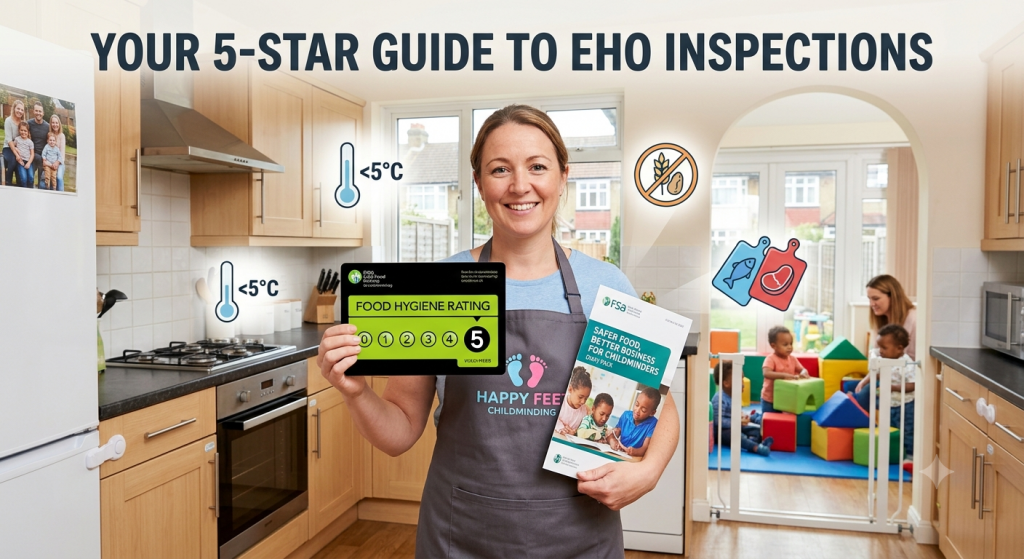
If you scroll through early years support groups, you will find hundreds of threads dedicated to Ofsted inspections, learning walks, and tax returns. Yet, there is another regulatory body that has the legal right to walk into your home, inspect your kitchen, and audit your paperwork: Environmental Health.
For many childminders, the relationship between early years childcare and commercial food safety law feels like an uncomfortable fit. You are running a home, not a high-street restaurant. However, the moment you provide a toddler with a cup of milk, slice a banana, or reheat a home-cooked meal, you are legally classed as a Food Business Operator (FBO) under UK law.
With recent updates to the Early Years Foundation Stage (EYFS) strengthening the emphasis on nutritional guidance and strict allergen compliance, keeping your kitchen legally sound is essential.
This comprehensive guide covers the high-volume, highly searched topic of Childminder Food Hygiene and EHO Inspections, outlining what you need to do to secure a 5-star rating without losing your mind.
1. Do You Actually Need to Register as a Food Business?
There is a common misconception that childminders must submit a separate, complicated application to their local council’s environmental health department before serving food.
Fortunately, the administration has been streamlined. If you registered as a childminder, Ofsted automatically shares your details with your local authority’s Environmental Health team. You are registered as a food business by default during your registration process. If you are currently navigating this initial setup phase, our step-by-step childminder registration course covers how these multi-agency data handovers work from day one.
The Exemptions: When Food Law Does Not Apply
According to the Food Standards Agency (FSA), you are generally exempt from food business regulations only if you provide the absolute bare minimum, such as:
Only providing mains tap water.
Storing packed lunches provided by parents in your fridge (without opening or prepping them).
Offering occasional, non-routine food items (like a single birthday cake to celebrate a milestone).
If you regularly provide snacks, breakfast, lunch, or even just soft drinks, you are fully covered by food hygiene legislation.
2. Will an Environmental Health Officer (EHO) Inspect My Home?
Yes, but the frequency depends entirely on your local authority and your specific business model.
Because domestic childminders are historically categorised as low-risk food businesses, many local councils operate an “alternative enforcement strategy.” This means instead of a physical inspection, they might mail you a self-assessment questionnaire to complete.
However, an EHO will conduct a physical, unannounced inspection of your home if:
A parent or member of the public files a food safety or hygiene complaint against your setting.
An outbreak of food poisoning is linked to your childcare service.
You operate a larger, multi-adult setting that pushes you into a higher risk category.
3. The “Safer Food, Better Business” (SFBB) Pack: Your Legal Shield
Just as the EYFS is your framework for education, the FSA’s Safer Food, Better Business (SFBB) Pack for Childminders is your framework for kitchen compliance.
You are legally required to show a written food safety management system. The SFBB pack is specifically tailored for home childcarers, making it significantly shorter and simpler than the commercial restaurant version.
To satisfy both an EHO and an Ofsted inspector, your SFBB pack must be fully completed and up to date, focusing on the four pillars of food safety:
Cross-Contamination
You must demonstrate how you keep raw foods entirely separate from ready-to-eat foods. In a compact domestic kitchen, this means utilising specific cutting boards and storing raw meat on the bottom shelf of your fridge.
Cleaning
An EHO will want to know what cleaning products you use. You must use a food-safe, non-tainting antibacterial spray or sanitizer that meets British Standards (BS EN 1276 or BS EN 13697). You should also know the required “contact time”—the number of seconds the spray must sit on the counter before you wipe it away.
Chilling
Your fridge must operate at 5°C or below to ensure food remains safely stored at 8°C or below. While domestic childminders do not necessarily need to log daily temperature grids in a separate folder, you must note any exceptions or appliance failures directly within your SFBB diary sheets.
Cooking
Commercial kitchens use food probes to test internal temperatures. For a domestic childminder, the SFBB guidelines state that verifying food is “steaming hot throughout” before serving is sufficient.
4. The 14 Allergens: Managing the Matrix
Allergen management is a zero-tolerance area for inspectors. Under the EYFS, you must obtain clear records of children’s food allergies and special dietary restrictions before they start attending your setting.
However, food law goes a step further: you must be able to verify exactly which of the 14 statutory allergens (such as milk, eggs, gluten, lupin, or molluscs) are present in the meals you serve.
The easiest way to remain compliant is to use a Menu Matrix – a simple grid detailing your weekly meals against the 14 allergens. When parents ask what is in their child’s lunch, your information must be:
Consistent: The same response is provided every time.
Verifiable: Backed up by product packaging or explicit recipes.
5. The Hidden EHO Triggers: Pets, Teatowels, and Nappies
When an EHO walks into a family home, they look for specific domestic habits that pose cross-contamination risks in a commercial context.
Pets in the Kitchen: If you have a family dog or cat, their food and water bowls must not be located in the kitchen during business hours. Pets must be excluded from food preparation zones, and children must not have access to pet waste areas.
The Dreaded Tea Towel: Using a single, damp fabric tea towel to dry child plates, wiping sticky hands, and drying your own hands is an automatic compliance failure. Air-drying or utilizing single-use paper towels for business tasks is highly recommended.
Nappy Changing vs. Food Prep: Your nappy changing station must be entirely separate from your kitchen and food serving zones. You must never wash potties or dispose of soiled nappies near areas where food or infant formula is handled.
6. Sourcing and Traceability: Keep Your Receipts!
Food law requires a clear chain of traceability. If a product is subject to a nationwide recall due to contamination, you must be able to prove where you bought it.
The easiest way to satisfy this requirement is to systematically archive your grocery shopping receipts. Whether you store them digitally or in a physical folder, ensure they are organised so that if an enforcement officer asks to check the supply chain of a specific batch of eggs, you can retrieve the receipt immediately. Conveniently, tracking these grocery receipts also keeps your tax deductions completely accurate; you can see how food costs tie into your broader overheads in our breakdown of childminder start-up costs and profitability.
7. Scaling to CoDP: Turning a Kitchen into a Commercial Operation
The food safety dynamic changes drastically when you scale your business up. Under standard childminding rules, you might be cooking for three or four toddlers.
However, if your setting grows to the point where you employ multiple assistants and register as Childcare on Domestic Premises (CoDP) (the transition triggered when five or more adults work on-site), your home kitchen is effectively feeding a small school.
For a CoDP setting:
Physical Inspections Are Standard: Your local authority will routinely visit your premises and assign an official Food Hygiene Rating (from 0 to 5) that parents can look up online.
Formal HACCP Implementation: You will likely need to move past the basic childminder SFBB pack and implement a more robust Hazard Analysis Critical Control Point (HACCP) system.
Staff Training Logs: You must prove that every single assistant or co-minder helping with food prep holds a valid Level 2 Food Safety in Catering qualification.
To ensure your corporate structure matches these strict group-setting standards, utilising pre-vetted approved nursery policies and procedures helps ensure your food safety protocols are fully compliant. If you are preparing to step into this managerial role, our Open a Nursery from Home (CoDP) course provides dedicated modules on managing commercial environmental health standards within a residential property.
8. EHO Compliance Checklist for Home Childcarers
Before an inspector arrives or you complete your council assessment, ensure you can tick off these essentials:
[ ] Completed SFBB Pack: Every relevant “Safe Method” section is signed and dated.
[ ] Allergen Matrix: A verifiable grid detailing ingredients for all snacks and meals.
[ ] Thermometer Check: A fridge thermometer confirming the unit is cooling below 5°C.
[ ] Approved Sanitiser: Antibacterial spray compliant with BS EN 1276 or BS EN 13697.
[ ] Pet Management: A clear routine that isolates pet feeding away from food zones.
[ ] Traceability File: An organized archive of food shopping invoices and receipts.
Conclusion
Registering as a food business operator might feel like an administrative burden, but it serves a vital purpose: protecting the vulnerable children in your care. By integrating the simple principles of the Safer Food, Better Business pack into your daily routine, you turn your domestic kitchen into a highly compliant, professional food environment.
Whether you choose to keep your practice small and nimble, or use our free guide to opening a full nursery to transition your business out of your home entirely, mastering environmental health requirements ensures your business stands on a foundation of absolute safety and professionalism.
The Childminding Journey Made Simple: Your All-in-One EYFS Solution
If the EYFS still feels overwhelming, that’s normal.
Every childminder feels this way at the beginning.
That’s exactly why I created the Become a Registered Childminder in the UK – Step-by-Step Course.
Inside the course, you’ll get:
✔ Clear EYFS explanations (no jargon)
Understand what Ofsted wants and how to meet the requirements easily.
✔ Real examples from childminders I’ve trained
Learn how they passed inspection and set up their homes.
✔ Ready-made templates
Policies, contracts, risk assessments, planning sheets.
✔ Video walkthroughs of each step
So you never feel lost or overwhelmed.
✔ Everything for just £49
And you keep all your profits — no agency fees.
Why This Course is Your Essential Tool:
Saves Months of Guesswork: Get clear, beginner-friendly guidance with no jargon, so you know exactly what to do and in what order.
Avoids Costly Mistakes: Set up correctly from the very start, avoiding common pitfalls that delay registration or cost you money.
Everything You Need: The course provides clear video lessons, written guides, essential checklists, and editable templates for your policies and contracts.
Proven Support: Built by professionals who’ve opened nurseries and successfully registered multiple childminders, giving you real inspection examples.
Affordable Investment: For a single, one-time payment of £49.00, you get lifetime access and save hundreds in potential agency fees by learning to register directly.
By the end of this course, you will not only know exactly how to register with confidence but also be ready to run your business professionally and profitably.
Ready to take the confusion out of registration?
Not Ready to Enrol Yet? Get Your Free Childminder Startup Guide
We understand that becoming a childminder is a big decision, and you might need a little more clarity before investing.
Download our FREE Childminder Startup Checklist to get a head start on planning your business and preparing your home.
Inside, you’ll get:
-
The 3 Essential Steps you can take today without spending a penny.
-
A breakdown of the initial costs to expect.
-
A summary of the required space and equipment.
This is the perfect next step for anyone in the planning stage.