
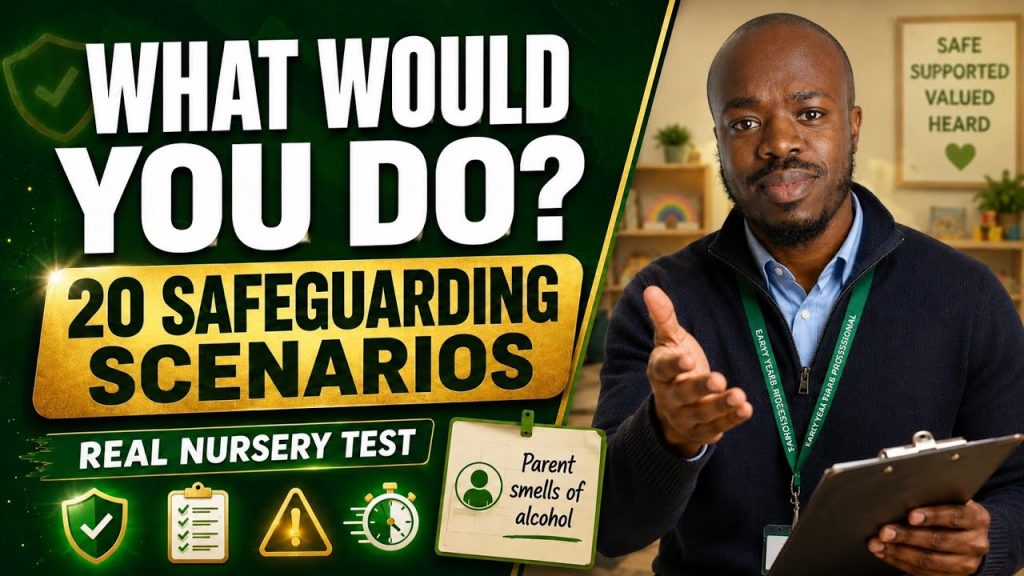
What Would You Do? The 20-Scenario Early Years Safeguarding Reflex Test
Knowing textbook definitions of neglect or abuse is straightforward. However, knowing exactly how to respond when an intoxicated parent arrives at your nursery door or when a colleague mishandles a child requires immediate professional reflexes. In early years settings, high-pressure situations unfold without a pause button.
This interactive scenario audit presents 20 real-world, high-pressure situations encountered by nursery staff. Evaluate each situation, click to reveal the legally required action and rationale, and track your performance to verify whether your practice is law-led or habit-led.
Round 1: Front Door Dynamics
Handover periods during early mornings and late afternoons represent some of the most critical safeguarding touchpoints in a nursery setting.
Scenario 1: A father arrives to pick up his daughter. He is stumbling slightly, smells strongly of alcohol, and is holding car keys in his hand. What is your immediate action?
The Decision: Attempt to delay departure immediately and contact another authorized emergency contact. If the parent insists on driving away with the child, notify Social Care and the Police right away.
The Why: You hold a statutory duty of care to protect the child from immediate danger. While staff cannot physically restrain an adult, you must take all possible steps to prevent the child from entering a vehicle with an impaired driver.
Scenario 2: At drop-off, a mother explains her son “fell on a toy,” causing a bruise on his back. Upon inspection, the bruise is a straight, narrow line that does not match a toy shape. What do you do?
The Decision: Record the mother’s exact statement word-for-word and immediately report the inconsistent injury to your Designated Safeguarding Lead (DSL).
The Why: Physical injuries that contradict the provided explanation are primary indicators of non-accidental harm. Documenting verbatim statements provides objective evidence for DSL evaluation.
Scenario 3: An unfamiliar individual arrives to collect a child. They lack the security password, but the child happily runs to them shouting “Grandpa!” Do you release the child?
The Decision: Absolutely not. Refuse collection until identity and authorization are verified with the primary carer.
The Why: Emotional recognition from a child does not equal legal collection authority. Collection policies must strictly be enforced without exception, regardless of familiar interactions.
Scenario 4: A parent loudly discusses a private bruise found on their child while standing in a crowded reception area surrounded by other families. How do you respond?
The Decision: Calmly interrupt and escort the parent into a private office immediately.
The Why: Maintaining child and family confidentiality is a legal requirement under GDPR and safeguarding regulations. Safeguarding discussions must never occur in public view.
Scenario 5: A child arrives for the fourth time in one week wearing a dirty nappy and damp-smelling clothing. The parent states their washing machine is broken. Is this an informal chat or a logged concern?
The Decision: Log this formally on a Low-Level Concern or Neglect record immediately.
The Why: An isolated occurrence represents an unfortunate incident; consistent repetition indicates a persistent pattern of neglect. Identifying patterns early prevents neglect from escalating.
Round 2: On The Floor (Classroom & Environment)
Active monitoring requires distinguishing between typical childhood behaviors and potential safeguarding red flags during everyday activities.
Scenario 6: Two 4-year-old children in the role-play area have lowered their trousers and are touching genital areas during a game of “doctors.” What is your first move?
The Decision: Stop the play gently, separate the children without shaming them, and report the occurrence to the DSL.
The Why: While natural curiosity occurs, sexualized behavior involving body exploration must be formally recorded. The DSL must evaluate whether the behavior is age-appropriate or indicates potential abuse elsewhere.
Scenario 7: A child repeatedly eats playdough and scavenges for leftover food scraps from the bin following snack time. What does this indicate?
The Decision: Treat this as a key behavioral indicator of potential food deprivation and neglect.
The Why: Persistent food obsession or eating non-food items strongly suggests basic nutritional needs are not being met at home.
Scenario 8: The sleep room thermometer reads 23°C. Sleeping infants have blankets pulled up to their chins. What safety hazard is present?
The Decision: Immediate risk of overheating and suffocation. Adjust room ventilation and lower bedding below shoulder height immediately.
The Why: Safe sleep rules require temperatures between 16°C and 20°C. High room temperatures combined with elevated bedding significantly increase Sudden Infant Death Syndrome (SIDS) risks.
Scenario 9: During a nappy change for a non-mobile 5-month-old infant who cannot roll or crawl, you notice a small bruise on their thigh. How serious is this?
The Decision: This requires an urgent, top-priority Category 1 safeguarding escalation.
The Why: Standard child protection protocol dictates: “Those who don’t cruise, don’t bruise”. Bruising on a non-mobile infant is a critical red flag for physical abuse.
Scenario 10: A frustrated parent roughly yanks their child’s arm at drop-off and shouts, “Shut up or I’ll give you something to cry about!” What action do you take?
The Decision: Safely intervene to de-escalate, comfort the distressed child, and document the incident under Parental Behavior.
The Why: Aggressive adult behavior in public settings often reflects a muted version of actions taking place behind closed doors, signaling potential physical or emotional harm.
Round 3: Staff and Colleague Concerns
Maintaining professional standards requires establishing a culture of challenge, prioritizing child safety over professional relationships.
Scenario 11: You enter the nappy changing area and observe a senior staff member with their personal mobile phone resting on the counter while changing a baby. What is your response?
The Decision: Report this as a Low-Level Concern to the DSL or Nursery Manager immediately.
The Why: Mobile phone prohibitions in changing areas exist to protect children and staff. Regardless of intent, personal devices in care areas represent a serious safeguarding policy breach.
Scenario 12: You report a valid child protection concern to your manager, who dismisses it saying, “That family are personal friends of mine, don’t worry about it.” What is your next step?
The Decision: Whistleblow directly to Social Care or Ofsted.
The Why: When internal leadership fails to address safeguarding concerns due to personal bias, practitioners hold a statutory obligation to escalate externally.
Scenario 13: You observe a colleague roughly pull a toddler’s arm to force them to sit down for lunch. The child is distressed but uninjured. How do you handle this?
The Decision: Report the incident to the DSL/Manager immediately as an allegation of rough handling. Do not attempt an informal peer discussion.
The Why: Physical handling must only occur to prevent immediate harm, never out of frustration. Managers must review allegations formally via local authority procedures.
Scenario 14: In the staff room, a colleague discusses details of a parent’s mental health struggles derived from an active safeguarding file. How do you respond?
The Decision: Intervene to stop the discussion and report the confidentiality breach to the DSL.
The Why: Safeguarding information is restricted on a strict “need-to-know” basis. Disclosing sensitive file details violates professional standards and data protection legislation.
Scenario 15: A parent sends you a private social media message requesting advice about their child’s home behavior. Do you reply?
The Decision: Do not reply. Screenshot the message and inform your nursery manager.
The Why: Communicating with parents via private social media channels compromises professional boundaries and objectivity.
Round 4: Direct Disclosures
Receiving a direct verbal disclosure requires immediate adherence to legal recording guidelines while supporting the child calmly.
Scenario 16: A child whispers, “Mummy hit me last night, but please don’t tell her I told you. She’ll be cross.” What is your exact reply?
The Decision: State clearly: “I am glad you told me, but I must tell someone who helps keep you safe. I cannot keep secrets”.
The Why: Practitioners must never promise absolute secrecy to a child disclosing harm. Reassure the child while maintaining transparent reporting boundaries.
Scenario 17: During group time, a young child uses explicit, adult anatomical vocabulary to describe genital parts, causing other children to laugh. What action do you take?
The Decision: Transition the child to a quiet area for a supportive conversation and report the exact vocabulary to the DSL.
The Why: Explicit adult terminology in early years settings can indicate exposure to inappropriate material or direct abuse, requiring objective logging.
Scenario 18: After asking an open question like “Tell me about that mark on your leg,” the child suddenly goes silent, stares at the floor, and stops speaking. Do you ask further questions?
The Decision: Stop questioning immediately, offer quiet reassurance, and log the non-verbal reaction on your record.
The Why: Pressuring a child can compromise evidence or cause distress. Sudden silence during questioning serves as a behavioral indicator itself.
Scenario 19: A child mentions playing a “secret game” on their home tablet with a “special online friend.” How do you classify this concern?
The Decision: Escalation to the DSL as a high-level concern for online grooming.
The Why: Digital threats and online grooming risks require the same urgent escalation as physical abuse indicators under current guidance.
Scenario 20: A child makes a disclosure of severe harm, and you become overwhelmed, breaking into tears in front of them. Is this an effective response?
The Decision: No. Practitioners must maintain a calm, supportive posture during disclosures.
The Why: Observing visible adult distress may cause a child to retract details or withhold information to protect the adult. Maintain composure during disclosures and debrief privately with management afterward.
Safeguarding Level 2: Real-World Professional Confidence
Moving from theoretical rules to high-pressure execution requires structured training. Hesitating during critical handovers, disclosures, or staff concerns creates vulnerability for children and nursery settings alike.
Our Ofsted-aligned Level 2 Safeguarding Course bridges the gap between knowing statutory requirements and executing law-led practice under pressure. Receive comprehensive training on physical indicators, whistleblowing frameworks, safer sleep rules, and digital safety. Save 20% on enrollment using code SafeYoutube at checkout.
- Practical Scenarios: Master step-by-step responses to complex classroom disclosures and staff concerns.
- Statutory Compliance: Align setting procedures with current legal frameworks.
- Formal Certification: Gain certified proof of Level 2 safeguarding competence for staff inspection files.
Evaluating Your Scenario Reflex Score
- 18 to 20 Correct (Safeguarding Champion): Exceptional performance. You possess sharp professional instincts and clear statutory knowledge.
- 13 to 17 Correct (Practice Hesitation): Good baseline knowledge, but hesitation in high-pressure scenarios leaves room for error. Reviewing statutory escalation pathways will refine your practice.
- Under 12 Correct (Urgent Action Required): Relying on subjective judgment rather than legal procedure creates significant operational risks. Structured refresher training is strongly advised.
Establishing Law-Led Safeguarding Reflexes
Safeguarding in early years settings demands immediate, clear action. Equipping yourself and your nursery team with structured statutory knowledge ensures every practitioner responds with confidence when challenges arise.
Regularly reviewing real-world scenarios in team meetings reinforces high standards, eliminates policy gaps, and ensures child protection remains the central priority across your setting.
Never miss a YouTube video breakdown
Subscribe to get the official companion articles, full written breakdowns and structural summaries from my latest YouTube videos delivered directly to your inbox as soon as they drop.
Join the video blog list
Enter your details below to receive the exclusive written guides, notes and compliance documentation that go alongside my channel uploads.